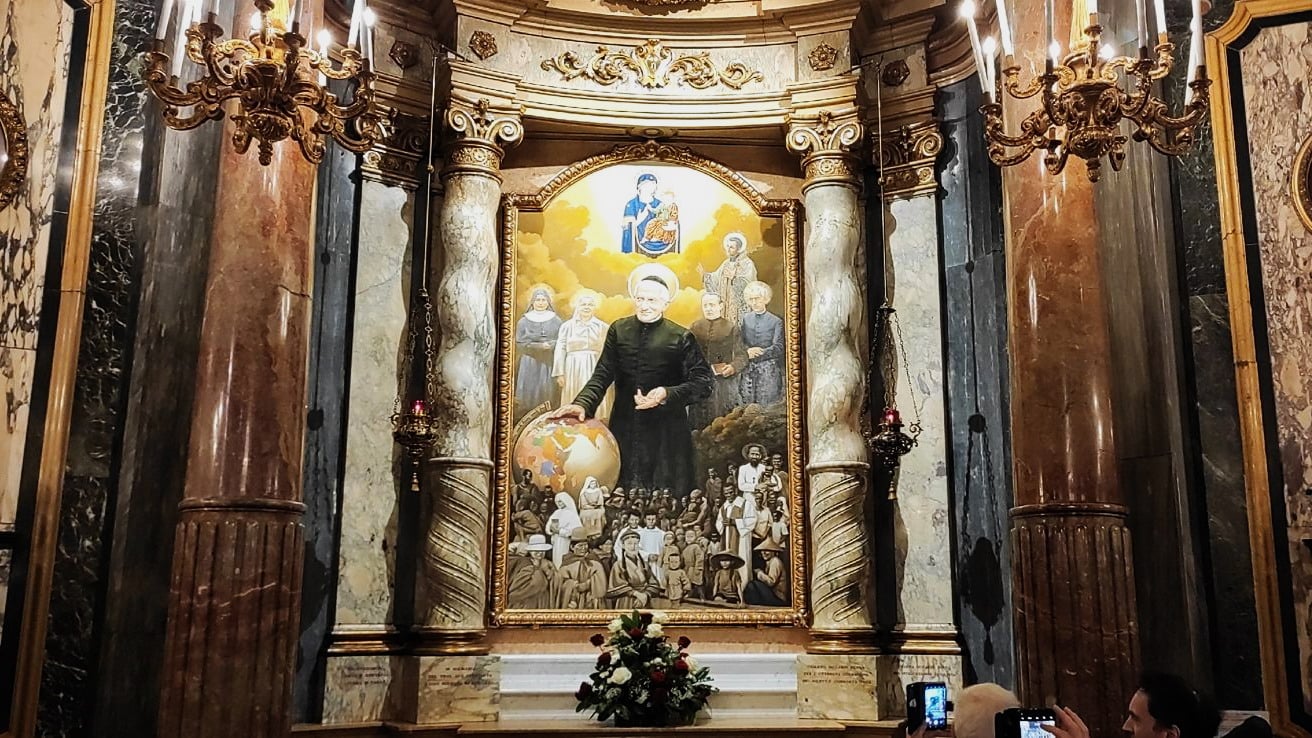
In the Shrine, at the foot of the icon of the Consolata, many stopped to pray: common people, rich and poor, young and old; popes and members of the nobility. Among them all, however, the “social saints” stood out in the 19th century, who dedicated their lives to serving the poor, the marginalized, and all those in need.

Blessed Francis Faà of Bruno (1825 – 1888)
Born into a noble family, before being ordained a priest, he was a professor at the University of Turin, an architect and mathematician, an astronomer, and an advisor to the Royal House of Savoy. Francesco Faà di Bruno is counted among the “social saints” for his initiatives, particularly for women.
He organized a chain of “economic cookers” to distribute low-cost hot meals to workers; a “circulating library” with a book lending service extended throughout Italy; The “public washhouses” to help citizens keep their homes and people clean and tidy. His motto was:
“He who does his best always does well.”

Saint Leonard Murialdo (1828 – 1900)
In 1873, he founded the Congregation of St Joseph (Josephines of Murialdo), with the aim of educating young people, especially the poor and abandoned. He collaborated on many social initiatives to defend young people and workers.
He launched several innovative initiatives: a family home (the first in Italy), an agricultural colony, oratories… Murialdo was also a great promoter of the Catholic press. His mottos were:
“Let us do and be silent”
“He who humbles himself will be exalted.”

Blessed Maria Enrichetta Dominici (1829 – 1894)
Caterina Dominici joined the nuns of the Congregation of Saint Anne and Providence, founded by the Marquises Tancredi and Giulia di Barolo. It was she who opened the Congregation to the horizon of mission: the first six nuns left for India in 1871, fulfilling a dream she had nurtured as a girl.
In October 1879, she visited the Institute’s first house in India, in Secunderabad. The certainty that Mother Enrichetta Dominici cultivated throughout her life and transmitted to those who approached her was:
“God is a good Father; He knows everything, can do everything, and loves us.”

Saint Joseph Marello (1846 – 1895)
He founded the “Oblates of Saint Joseph.” He was an example and model of charity toward all: young, old, poor, marginalized…
From his meetings with Don Bosco, his affectionate words, his precious advice, and his long prayer sessions at the Consolata Shrine, Fr Marello found the strength to continue his tireless work on behalf of the least fortunate.
“Be extraordinary in ordinary things.”

Saint Luigi Orione (1872 – 1940)
A founder of congregations, St Luigi Orione met with Allamano several times at the Consolata Shrine. An important occasion that strengthened the relationship between the two men of God, writes Fr Pavese IMC, was the earthquake that razed Messina to the ground on the morning of December 28, 1908.
Already having a community of his own in Sicily, Don Orione went to Messina and generously provided material and spiritual assistance to the earthquake victims. One of his initiatives was to build a small church made of corrugated iron dedicated to the Consolata in front of the cemetery, in memory of the 80,000 earthquake victims.
For this church, he obtained a painting of the Consolata from Allamano. “Documents prove that the rebirth of our founder Don Orione’s missionary ideal dates back to the period in which he had long-term contact with Canon Allamano.”
There is no doubt that St Luigi Orione admired Allamano’s missionary spirit and that it inspired him and his Congregation.

Blessed Giacomo Alberione (1884 – 1971)
From Alba, Don Alberione traveled to the Shrine of the Consolata in Turin to meet Canon Allamano, one of the few priests who supported him and advised him on how to fulfill the mission he felt deep in his heart: to evangelize by proclaiming that Jesus Christ is the Way, the Truth, and the Life, using the rapid and effective means offered by the media.
Allamano suggested and encouraged him to start a congregation, and Alberione, following his advice, founded the Pauline Family, composed of five religious congregations, four institutes of secular consecrated persons, and a lay association, which still operates in the media world today.

Saint Pier Giorgio Frassati (1901 – 1925)
He was born into a wealthy middle-class family: his father, Alfredo Frassati, was a well-known journalist and his mother, Adelaide Ametis, an accomplished painter.
In the morning, he attended the first Holy Mass celebrated in the Sanctuary of the Consolata and then went up to the attics to visit, help, and console the poor.
It is almost certain that Pier Giorgio Frassati and Giuseppe Allamano knew each other. Canon Nicola Baravalle testified: “Upon hearing the news of Pier Giorgio’s death, the now elderly Rector wept.”
During high school, he attended the Works of St. Vincent and devoted his free time to assisting the marginalized of society. He was also a member of Catholic Action. His rule of life was: “let yourself be involved.”
Sr. Maria Luisa Casiraghi, mc