
July is a month that commemorates many beloved saints. One of these is the apostle St. James, chosen as the patron saint of Spain and the subject of a popular devotion that continues to this day. With the Conquest of South America by the Castilian Empire, the veneration of Santiago (as he is called in Spanish) took root in the Andean region, where the saint is linked to traditional medicine and healing. The common element in both contexts is pilgrimage, and also healing.
Santiago and the Way
Ten years have already passed, but the memory of the Way of St. James, undertaken with his son Emanuele, is still alive in Mauro. “There wasn’t a specific reason for doing the way,” he shares:
“It was a mix of seeking a spiritual experience and the chance to do something different with my son… Lots of little sensations… Since there was a friend who was doing this walk, we joined him.”
They left from Portugal, a very challenging route, and walked 300 km in 8 days.
“The first few days were tough: it was raining, it was cold. We were traveling wet.”
Then the weather improved. Once we arrived in Spain, there were many more people to share the march with, from early morning until the afternoon.
“We shared a good portion of the journey with some Italians, including a young woman diagnosed with muscular dystrophy who wanted to experience this before she lost her mobility. Another couple, English: he,with leg problems, walked with special canes for two kilometers a day, then traveled by bus from one point to another, but always following the pilgrimage route”.
On the Way, a fraternal atmosphere is immediately created: you never feel judged. Friendships are made, even if temporary.

When you arrive in Santiago de Compostela, you feel like you’ve reached your goal, that you’ve succeeded. You hug even those you don’t know. Some cry, some throw themselves to the ground in the square. Then you line up to get the parchment certifying your pilgrimage. And then… we enjoyed two days in Santiago. Thereafter, you focus on your journey.
Mauro, a permanent deacon, had just celebrated his tenth anniversary of ordination. It was a good time to take stock of the situation.

In a small side chapel of the Basilica, I found a Mass in Italian. The priest was asking those present why they had undertaken the journey. Each person responded with a personal reason. This priest explained that the main reason for the Way of St. James is to forgive those who have wronged us, with that traditional gesture pilgrims make of embracing the statue of St. James. It surprised and touched me deeply: after ten years, that gesture of forgiveness and reconciliation is still alive.
As the years pass, certain situations seem unchanging. The question that arises is more than natural: is it possible to forgive? It’s certainly not easy. But that experience of the Way of Santiago is still alive:
“Even in today’s situations, the powerful image of the embrace of St. James returns, this gesture of reconciliation and forgiveness.”
Forgiveness, which is a profound inner healing.
St. James and traditional medicine
Santiago, the patron saint of Spain, landed in America with the Conquistadors. In the first evangelization, he was presented as the “Son of Thunder,” as described in the Gospels, and in the Andes, a peculiar alchemy was immediately created with the world of traditional medicine. Indeed, one of the clear signs of a healer’s “vocation” is being struck by lightning and surviving.
In the Andean cosmovision, lightning is a bridge of energy between the “world above” and the “world here”. Whoever is struck by this energy then possesses it for the good of the community.
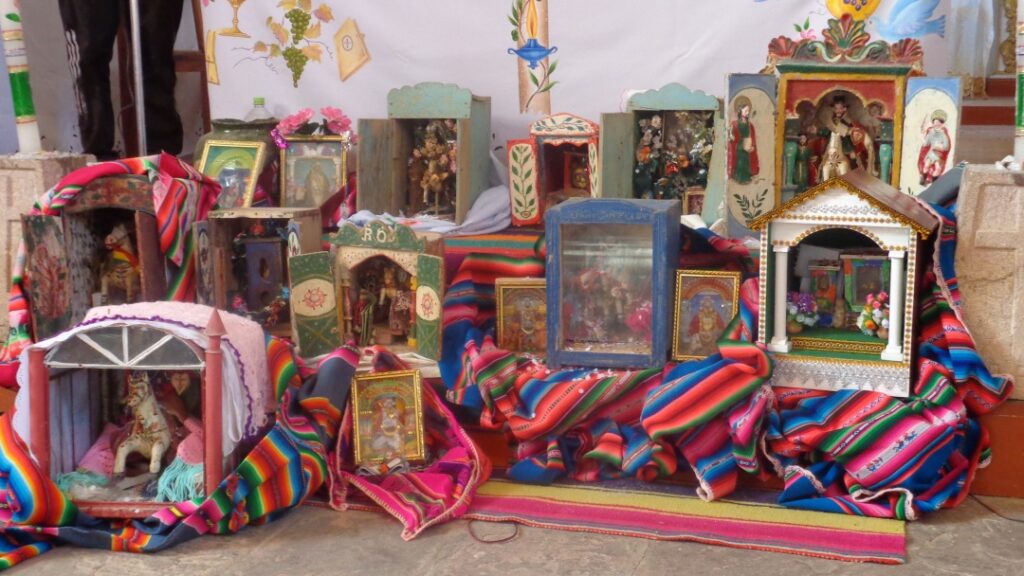
It is almost logical that the Saint “son of thunder” became the patron and helper of traditional doctors, who invoke him in their work of healing people.
In the Andes there are several sanctuaries dedicated to St. James, destinations of pilgrimages for many people seeking healing, and, of course, for all the traditional doctors, who turn to the saint to be able to carry out their service.
In the Andean cultural context, pilgrimages can take the form of dance: people who make a vow to the Saint commit to dancing for kilometers for three years toward the Saint’s shrine, dressed in the appropriate attire for their chosen dance.

It’s a significant physical effort, often performed at over 3,000 meters above sea level!
Dance becomes a prayer and a spiritual experience that, due to the commitment and effort involved, is very similar to the Way of Santiago in Spain.
Journey. Healing. Encounter with the Sacred. The traditional veneration of St. James/Santiago is a time for self-improvement and growth, as individuals and as believers.
Sr. Stefania Raspo, mc