
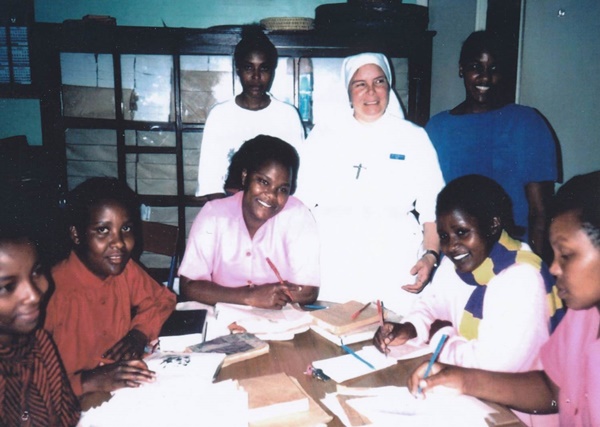
To love life means to place oneself at its service. Blessed Leonella Sgorbati, a Consolata Missionary, who spent her life serving the poorest, undoubtedly set an example of the greatest self-giving, down to the last drop of her blood. As a true daughter of St. Joseph Allamano, who wanted his Missionaries to be authentic, but above all, women fully in love with God, burning with missionary zeal and eager to make him known to the ends of the earth. Simple, profound, humble women, women of living faith, willing to give their lives at any cost, women of great charity, capable of giving themselves for the good of others. Blessed Leonella lived all these things deeply. She carried out her mission particularly in the missions of Kenya and Somalia. Her training as a professional nurse, midwife, and social-health assistant brought her particularly close to women. Wherever she worked, Sister Leonella demonstrated great interest in offering a comprehensive human, intellectual, religious, and technical-professional formation to young women aspiring to the nursing profession. For her, the value of the individual and service to life were fundamental aspects, which had to penetrate every fiber of her students. There was no discussion about this, because being a nurse was not just a job, it was a vocation, a calling to bear witness to God’s love for those who suffer. And she was the first to live this, not only with her patients, but also with her students. She cared for them, knew each one by name, ensured they were well-fed and that the quarters where they lived were decent. She was attentive to all their needs and sought to reconcile love with appropriate severity. She protected and loved them like a true mother, to the point that if one of them became pregnant—contrary to the regulations—she could continue her studies, acting as an intermediary with the family and also supporting them financially. With pregnant women and those who had just become mothers, she displayed an ineffable kindness and mercy. She had fifty beds available on the ward. She always found a way to add more. She couldn’t bring herself to send a pregnant woman home, perhaps even walking for miles, just because she was still a week away from giving birth. Here, in these brief brushstrokes, is Sister Leonella’s approach to women. Sister Leonella was a true mother, friend, and counselor to women, who devoted all her energy to seeking their well-being, to ensuring that they reached the highest peaks and that they too would be witnesses of God’s love for the poor and the marginalized of society. Sr. Gloria Elena López, mc

GESTURES of WOMAN – In Mozambique
In Mozambique, in the province of Inhambane, there is a group of “Consolata Missionary Women.” The original idea came from the Consolata Missionaries of Portugal, where they already existed. This movement is open to all women—married, single, or widowed—who, driven by an enlightened faith, passionate about God, and conscious of their Christian mission, are willing to collaborate with the Consolata Missionaries. As a movement, they are inspired by the Charism of Saint Joseph Allamano and focus on love for the Eucharist, Our Lady of Consolation, and missionary zeal. They spread the missionary ideal and support the missionaries’ projects, according to their means. The history of the MMC, as they are known in Mozambique, dates back to the time of Sister Teresa José, a Brazilian Consolata Missionary who worked in that country and was also passionate about the advancement of women. She encouraged women to visit families, the sick, and prisoners, and gradually this habit became a weekly practice. During their visits, they spoke of the Consolata, of her missionary zeal, but also of Saint Thérèse of the Child Jesus and her ardent desire for everyone to know Jesus. Another pastoral task they faithfully undertook was active participation in funerals, showing solidarity with families and offering consolation (to support them in times of mourning). The choice of the name was inspired by Mary Consolata and Saint Thérèse of the Child Jesus, with the motto: “In the heart of the Church I will be love.” They celebrate the feasts of the Consolata and Saint Thérèse together. Over the years, the movement has grown and expanded to other communities within the parish, and its autonomy and self-management have grown accordingly, within the limits of their capabilities. The group has leaders and organizes itself to respond to needs, whatever they may be. The parish recognizes their contribution and offers support. Every Saturday morning, they preside over the liturgy, recite the rosary, and then meet briefly to organize the week’s work. They are divided into zones and are responsible for their care. We are encouraged by the commitment of this group: indeed, they are like leaven, needing very little, nurturing the Christian values of communion, solidarity, and love, and demonstrating that they need little else except trust in God and availability. Like Mary, they collaborate in the work of salvation. Sr. Julia Muya, mc

Centenary Celebrations: Nairobi, Kenya
“ A life that cannot be confined to the past” were the opening remarks of the homily given by His Excellency Archbishop Hurbetus Maria Van Megen, Apostolic Nuncio to Kenya during the centenary celebrations of birth into Heaven of St Joseph Allamano.

GAZE of WOMEN. In Djibouti
The gaze of women in Djibouti, a Muslim country. And the gaze of the Consolata Missionary Sisters on Djiboutian women.

The Father comes Home
Turin, the capital of the Piedmont region, was founded by the Romans in the 1st century BC. The city is immersed in greenery, gently nestled among the hills, crossed by the Po River and surrounded by the Western Alps. Turin was Italy’s first capital, and among its many churches rich in art, the Sanctuary of the Consolata stands out. It was in this sanctuary that Saint Joseph Allamano returned to the house of the Father on February 16, 1926. During the funeral, as the body of the rector of the Consolata was being carried to the cemetery, someone said: “Canon Allamano will not stay at the cemetery, but will return home.” And an article published on February 18, 1926, in the newspaper “Il Mattino” concluded: “Canon Allamano cannot rest except in the Sanctuary of the Consolata or with his Missionaries. His heart, his spirit, his smile, his charity remain where he spent his entire life in holiness.” These “prophecies” came true 12 years later, when on the morning of October 11, 1938, the coffin containing Allamano’s remains was transported from the general cemetery to the church next to the Mother House of the Missionaries and, in the afternoon, was buried in a sarcophagus located in a side chapel. The Father returns home, among his sons and daughters! Indeed, beyond the stained-glass window behind Allamano’s sarcophagus, which overlooks the courtyard, stands the Missionaries’ Motherhouse, and a little further away, the Missionary SIster’s’ House. The two buildings were commissioned by Allamano to house those who entered the missionary family he founded. The Missionaries’ Mother House, built on a large plot of land on Circonvallazione Avenue, now Ferrucci Avenue, welcomed the Consolata Missionaries, founded by Allamano in 1901, in October 1909. For nearly a decade, they had resided at the “Consolatina” at Corso Duca di Genova 49, in a house they were forced to leave because there was insufficient space to accommodate other young people who asked to join the nascent missionary family. Canon Allamano, while continuing to reside at the Shrine of the Consolata, regularly visited the Mother House to oversee the formation of the young missionaries. He arrived promptly every Sunday afternoon and sometimes even during the week. Every opportunity was a good one to meet with his sons. The seminary’s “Diary” notes: “Since we have been in the new Institute, the Most Reverend Rector has rarely missed coming every day, generally from around 5:00 PM until around 7:30 AM.” The Mother House of Consolata Missionary Sisters The Consolata Missionary Sisters’ residence, founded by Allamano in 1910, was initially located in the “Consolatina,” which had housed the missionaries a decade earlier. In 1911, a year after its founding, Allamano began seeking better accommodations for the many young women entering the Institute. After several unsuccessful searches, Allamano and Camisassa decided to begin construction of the Missionary Sisters’ house near the Missionaries’ house, on land belonging to Allamano, overlooking Bruino Street and Coazze Street, which had been used as a vegetable garden. Construction work began on April 19, 1915, but due to the difficult war situation the country was experiencing, the Consolata Missionary Sisters’ community was only able to enter their Motherhouse on September 4, 1922. Allamano, like the missionaries, continued to train the missionaries, which is why he regularly visited their home. Two areas of the Missionary Sisters’ house are still charged with meaning and keep alive the Founder’s presence: the “hall” and the “green room.” The Hall The hall was the place where we met to celebrate with the Father, the Co-founder, and the Sisters. The Golden Thread (the Motherhouse diary) reports: “In the afternoon, after the blessing, we all gathered in the hall. Sisters! It is the Our Father we have been awaiting after three months. As soon as we see him, we burst into festive cheers. He passes among us as we make way for him, he looks at us all one by one, and his gaze brings such peace to our souls.” And again: “After the afternoon services, we greet in the hall, with a unanimous cry of jubilation, our beloved Father, whom we had not received among us for so long. ‘There are so many of you,’ he says, ‘but it’s not the number that counts, it’s the spirit.’” The Green Room The “Green Room” was the place for personal encounters with the Father. These were privileged moments of individual dialogue, discussion, and personal experience of the Charism that emanated from him. Mother Maria degli Angeli recounts: The Sanctuary of Saint Joseph Allamano The Sanctuary of Saint Joseph Allamano, known as the “Founder’s Church” because a side chapel houses the tomb of Saint Joseph Allamano. It is a sacred place, a destination for pilgrimages, a space that invites one to pause, pray, and meditate. According to ancient Christian belief, a saint’s tomb is like his earthly “home,” while he lives in perfect communion with God. It is the “dwelling” from which he continues to spread blessings, encouragement, and consolation. The body of saints, in fact, sanctifies the place where it is placed and those who frequent it: “it is a source of sanctification and blessing for all.” In this chapel, one truly feels as if one is in the home of Saint Joseph Allamano, feeling him alive and present: “the voice of these silent bodies is more powerful than that of the preachers”; here resounds the memory of Allamano’s words: “When I am up there, I will bless you even more.” This is how the Consolata Missionaries, Allamano’s devotees, and friends and collaborators of the missions have always considered this place; they come here to draw strength and inspiration. From this home, in his family, Saint Joseph Allamano instills “new life in the branches of the vine he planted and made fruitful.” On the sarcophagus, Allamano is depicted sending his sons and daughters on missions; this gesture is accompanied by the Latin inscription: “They will announce my glory to the people.” The name “Joseph Allamano” is carved in large letters on the slab sealing the sarcophagus. The

When the Heart Speaks – WOMEN’S WORDS
When discussing the right to education, the gender gap must be considered: two out of three illiterate people in the world are women.
But when a woman does succeed, what happens in her heart? We’ll tell you Mary’s story, her desire to study and help her family with dignified work.

Foundation Day and Centenary Celebrations in Mojo – Ethiopia
On 29th Jan, 2026 we joyfully celebrated our Foundation Day and the Centenary of Birth into Heaven of our Founder, St. Joseph Allamano. Our hearts were full of gratitude for it was truly a historic and grace-filled moment for all of us.
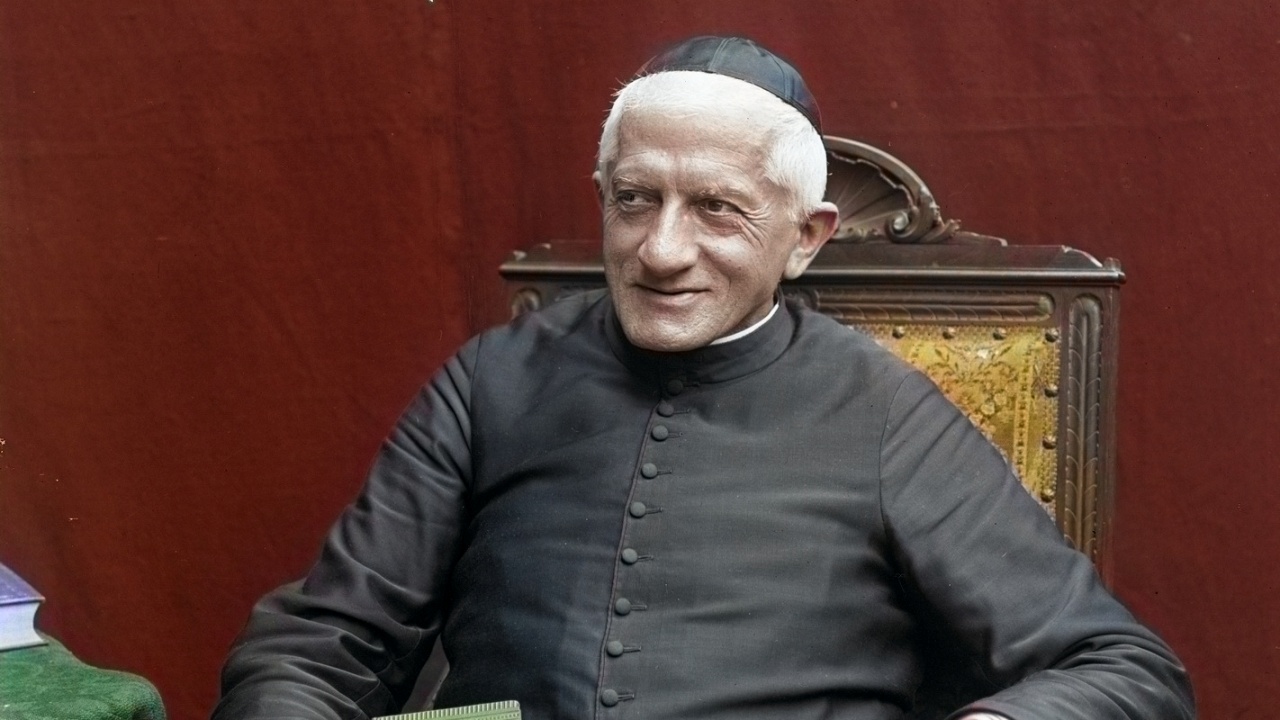
Contemplation and Action – The Gestures of Saint Joseph Allamano
Saint Joseph Allamano, in addition to contemplating Jesus in the Eucharist and engaging in dialogue with the Consolata, through gestures both large and small, became a “neighbor,” becoming the “word,” “hand,” and “face” of the God of Consolation.

Blessed Leonella Sgorbati: empathetic Connection with Saint Joseph Allamano
Empathy has been recognized by the World Health Organization (WHO) as one of the fundamental life skills and considered a central element because it forms the basis of many other skills essential for individual and collective well-being. To summarize the various definitions simply, we can say that empathy is the ability to perceive and share the emotions of others, to connect with others by deeply understanding them, to share in their suffering and joy, to sense their possible thoughts and respond to them appropriately. If we look at the issue from a biblical perspective, it emerges that God, revealed in the Sacred Scriptures, is not a distant God or indifferent to the events of the world. On the contrary, he is an empathetic God; He allows himself to be involved in human history, because he loves the man and woman he created, he loves creation and walks alongside them, making himself present and concretely, in their history. God’s empathetic nature is an invitation for every person to experience true and profound relationships: with God, with others, and with nature. God teaches us not to remain indifferent, but to participate with love and attentiveness in the life around us. Observing the bond between the founder of the Consolata Missionary Sisters, Joseph Allamano, and one of his spiritual daughters, Sr. Leonella Sgorbati, this attitude becomes clearer. Although she never knew the Founder personally, Sr. Leonella deeply assimilated his charism of consolation, embodying it in her missionary experience. Thus, she developed a profound empathy with him, embracing his spiritual legacy and translating it into concrete choices, lived with generosity and total dedication, as an authentic and consistent daughter. Her missionary life was a continuous offering, lived moment by moment, to the point of complete self-giving in martyrdom, faithful to the Founder’s teaching: “…You must all have the strength of spirit to endure martyrdom; but remember: this is a grace that the Lord grants to those generous souls in making small sacrifices.” Sister Leonella’s martyrdom was preceded by an intense interior experience with Jesus, God offered for the salvation of all, and by an intimate communion with St. Joseph Allamano. This bond was particularly evident a few months before her death when, pausing in prayer at his tomb, she opened her heart to him, saying: “Give me the grace of true discipleship. Grant me the gift of truly offering my life to Him every day, moment by moment, with fidelity, truth, mutuality, and total union. I ask you to truly be your daughter in following Christ, in union with Jesus in the Eucharist. I consecrate myself here, in your hands, renewing my vows to the Lord.” In conclusion, only someone like Sr. Leonella Sgorbati, capable of cherishing a legacy in her heart and entering into profound empathetic harmony with the Founder, can consistently welcome and value the gift she has received. It can be said, therefore, that she is a woman who not only shares Joseph Allamano’s passion for making Jesus known, but also inspires in others the desire to follow and proclaim him. “I desire a form of communication that can make us companions on the journey of so many of our brothers and sisters, to rekindle their hope in such a troubled time. A form of communication that is capable of speaking to the heart, of generating commitment, empathy, and concern for others.” (Pope Francis) By Postulation

At the Well of the Word – Saint Joseph Allamano
All gathered around him, we drank in his word, which filled our hearts with a great love of virtue. Father, he exhorted us with a kindness that gave us the strength to walk fearlessly on the path of holiness.