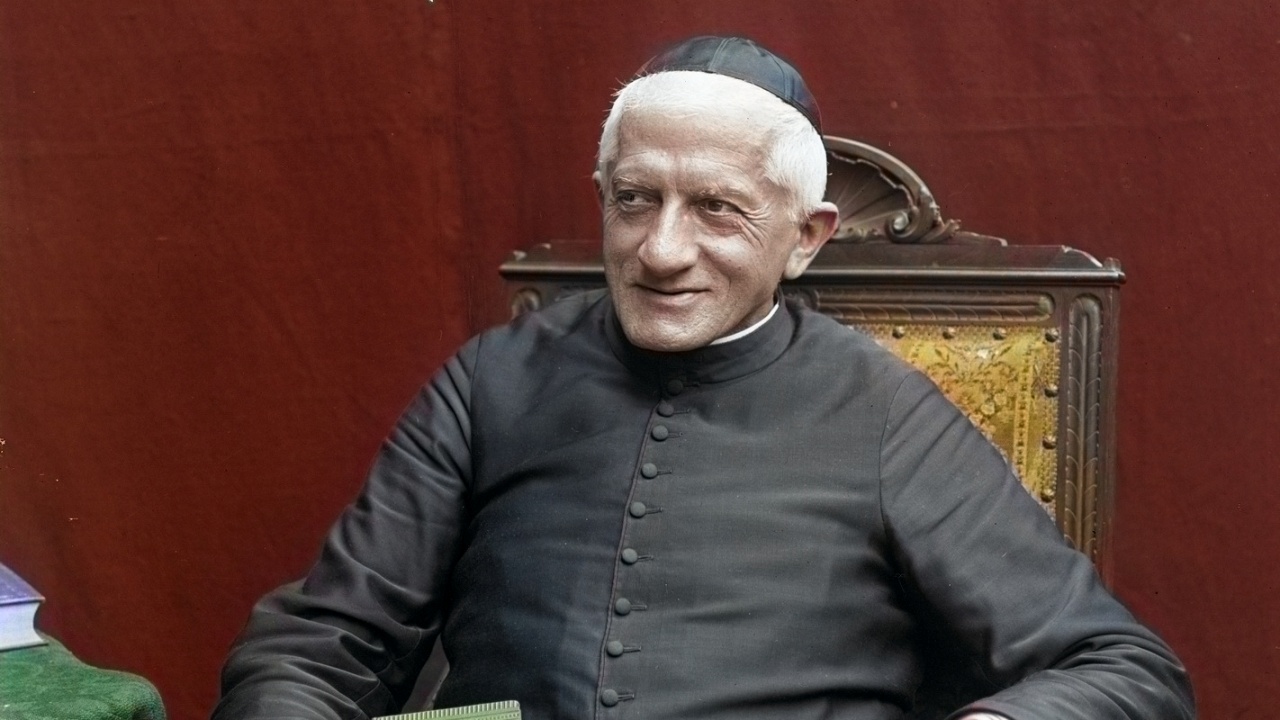
To understand Allamano’s influence on the society of his time, it is important to place his figure and his work within the historical, political, social, and religious context of Turin, Piedmont, and the Italy of the Risorgimento. In this contrasting era, Allamano harmonized his profound spirituality with a wise and far-sighted attention to the environment in which he lived and the people he encountered. He undoubtedly belongs to that group of men and women, religious or lay, who, throughout history, moved by the Spirit, embodied Charity in the most diverse ways; some of them through active life, others combining “contemplation with action,” just as Saint Joseph Allamano did.
The binomial “contemplation and action” experienced by the Rector of the Consolata Shrine emerged clearly during the diocesan information process, which initiated the process of recognizing Allamano’s sainthood by the Church. Witnesses, first and foremost his servant Cesare Scovero, emphasized that prayer took center stage on Allamano’s day:
“He was never idle, and he spent all his free time in prayer. He prayed at length in the sanctuary’s choirs, even in the evening hours; he prayed in his room, in the sanctuary, and even when he traveled. He made frequent and lengthy visits to the Blessed Sacrament from the sanctuary’s choirs, and during these visits, he remained in fervent prayer. Even in the evening, before his rest, he occasionally went to the choirs to visit. His entire life can be said to have been a life of prayer.”
Allamano, at Consolata, where he remained as Rector for 46 years, became a dispenser of mercy, serenity, and consolation for many. His intelligence and his watchful eye for what was happening in society earned him the sympathy of many, especially those who were disoriented or struggling. True to his style, he was not content to simply foster the renewal of Christian life, but knew how to harmonize profound spirituality with attentiveness to the challenges of his time.
He was certainly not a scholar of social problems, but simply considered it his duty to collaborate in the initiatives that animated the diocese in the social sphere, with some characteristics underlined by several witnesses:
“He knew how to keep quiet and act, without beating the drums, because good doesn’t make noise and noise doesn’t do good.”
“He had the art of not stepping forward.”
“He was the man who had more ideas than words.”
The Rector of the Shrine, in addition to contemplating Jesus in the Eucharist and engaging in dialogue with the Consolata, through gestures both large and small, became a “neighbor,” becoming the “word,” “hand,” and “face” of the God of Consolation.
He encouraged people from diverse social backgrounds to launch innovative projects. He was directly involved, until the end of his life, in protecting a particularly disadvantaged group at the time: young female workers in the clothing industry, commonly known as “seamstresses,” who earned little, worked grueling hours, and worked in appalling working conditions. The “seamstresses,” encouraged and supported, including financially, by Allamano, in 1899 opened the “Consolata Workshop,” which quickly opened branches in Genoa and Rome, where thousands of workers and managers in the fashion industry were trained.
In the 19th century, the Catholic press attempted to carve out a space for itself among the various publications, but it proved very difficult to achieve. Allamano supported the Catholic press, which he considered a privileged means of shaping public opinion. His financial support was crucial to the creation, or continuation, of some Catholic newspapers of the time.
Pope Benedict XVI, in his Message for Lent 2013, states:
“Sometimes we tend to limit the term ‘charity’ to solidarity or simple humanitarian aid. It is important, however, to remember that the greatest work of charity is evangelization. There is no more beneficial, and therefore charitable, action towards our neighbor than breaking the bread of God’s Word and introducing him to a relationship with God: evangelization is the highest and most integral promotion of the human person.”
At the time of Allamano, the local Church had established many charitable institutions, but none were dedicated exclusively to the missions. Convinced that a Church does not reach its full maturity until it looks beyond its own boundaries and needs, he decided to add that missing piece that would complete the face of his church: the Mission.
Allamano, enlightened by the Holy Spirit, driven by love for God and the desire to make Him known, founded first the Consolata Missionaries and then the Consolata Missionary Sisters. It was a demanding, laborious, and at times thwarted undertaking, but Allamano’s apostolic zeal, a keen sense of the Church’s missionary nature, and the constant protection of the Consolata sustained him.
Sister Maria Luisa Casiraghi, mc