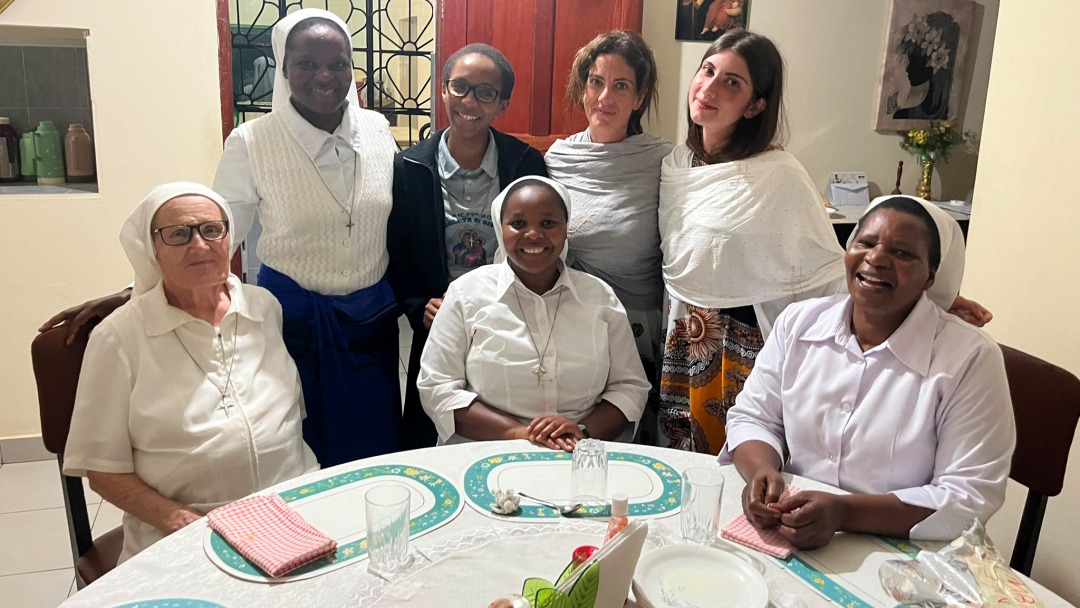

Djibouti, a small, predominantly Muslim country in East Africa. For over 20 years, the Consolata Missionaries have shared their lives with the people of the desert. In this interview, Sister Grace Mugambi and Sister Grace Kemunto share their community’s work for women.
What’s life like for a woman in Djibouti?
Djibouti is a Muslim country. Culturally, women are expected to stay at home; their role is to have children, raise them, take care of the house, and care for their husbands. But all of this happens within the confines of the home. When they go out, they must be accompanied. A high percentage of women are illiterate. Life in Djibouti is very hard, in general. And for women, life is very, very hard.
How do you concretely help women?
There are various organizations that promote education, and as the Church of Djibouti, we are deeply committed to this. But if families are encouraged to send their children to school, the opportunity is given to boys because, according to the common mentality, he will be the head of the household, responsible for the family, so it’s appropriate for the son to study. There is resistance to allowing girls to leave.
We try to motivate girls to come to school. We accompany them and communicate with their parents to ensure they have the opportunity to study.
The sewing and literacy programs at the LEC school (Lire, Écrire, Compter: an intensive literacy method designed specifically for Djibouti and implemented in informal schools) aim to help girls, who are often discriminated against.
But do the girls feel the desire to study?
The girls who study here, supervised by the Sister in charge, generally progress. Some, too, give up.
The sewing school offers the opportunity to learn a trade, thus helping and supporting the family by making clothes and buying food.
Many girls enjoy coming to the school: but they have to really rush, because first they have to work at home, and then they come quickly to school to learn to read and write. Then, returning home, they have a lot of work to do again. They make many sacrifices, but they want to learn.
The girls who, having passed the LEC, enter the College, return to happily report that their studies are progressing; sometimes they are top of their class. They love studying and want to change their lives.
Are there girls who have already graduated from college, or entered the workforce?
There are women who, having completed the cutting and sewing course, received a sewing machine and can make clothes, thus helping their families finances.
From the group of the first students in the sewing course, the teachers who now mentor the new students have emerged.
Of those who attended the LEC, some are at university.
Those who entered the college are doing well in formal school.
It’s a good sign for the future; there’s hope. They are small projects, but they give us so much satisfaction: it’s such a joy to see their progress, to show them love, to see them comforted.

Sister Grace M., you work at the hospital: what are the conditions for women in the healthcare sector?
Hospital workers who have studied are generally men, so hospital care is predominantly provided by men.
If a woman comes to the hospital alone, she’s discriminated against. I try to be approachable and considerate of women.
If a teenage girl comes in and needs an injection or an examination, she often doesn’t want to be visited by men. So they call me, and I help them with whatever they need.
Sister Grace K:
Working in communion among us Sisters, promoting education and healthcare, I often accompany mothers to the hospital when their children are sick or malnourished. Women suffer as they search for food for their children, which often isn’t available. In the Ali Sabieh mission, we also accompany children with disabilities to the inclusive school “Ecole pour tous.”
As a team, we can also work on prevention: preventing malnutrition and accompanying pregnant women during pregnancy are key factors in reducing disability in future generations and improving the conditions of children with disabilities. We feel a responsibility to accompany women to reduce the risk of disability in children.
This mission is beautiful because we feel we bring comfort; we are a presence of consolation for women. Even if we don’t speak directly about the Gospel, we love people and bear witness to God’s love.
Sr. Stefania Raspo, mc