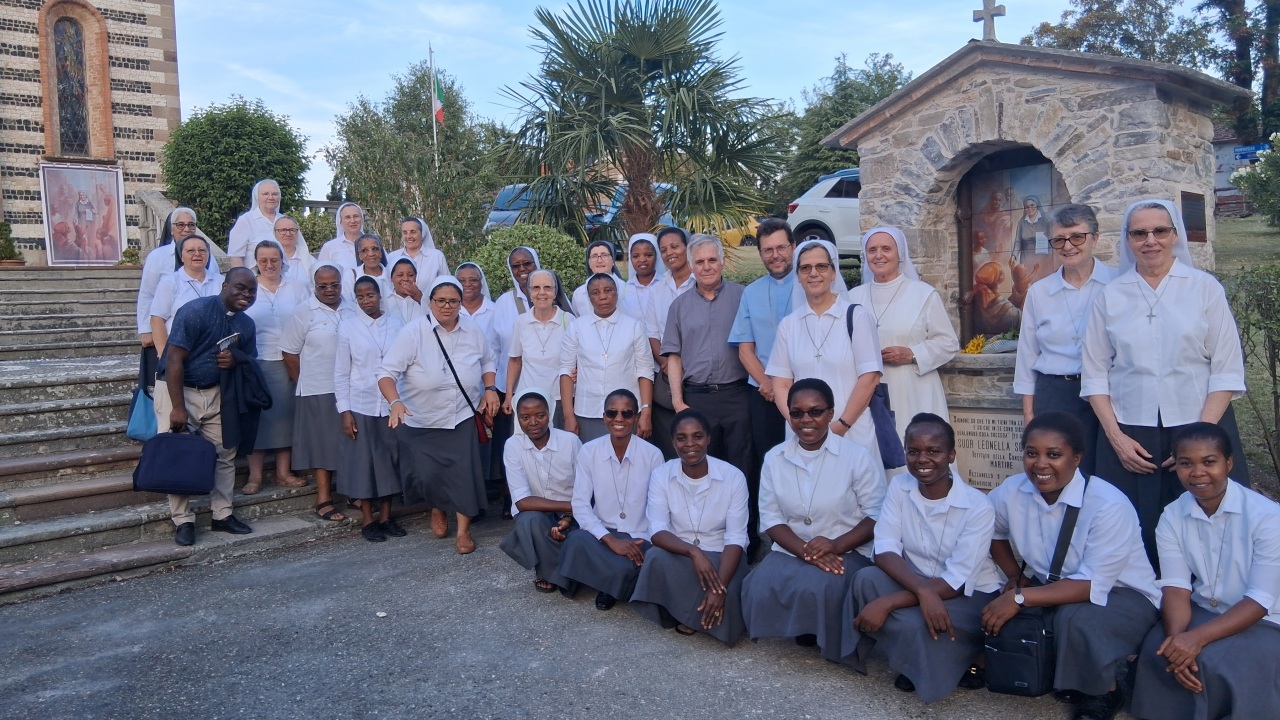

The lay Consolata Missionaries are on the second day of the International Meeting, beginning with prayer in the chapel, giving thanks to God for the gift of life and for continuing to walk together as a family; with fervour, they sang in unison “A golden ear of corn in the sun”.
They then gathered in the halls in groups organised by language (Portuguese – English – Spanish) to discuss the document “Description of the International LMC”. This document compiled the responses sent by the lay Consolata Missionaries via a Google form, offering an insight into the realities of life across a total of 15 countries.
This document offers an insight into the experience of the lay missionary, always starting from a community of life made up of other members of the IMC/MC. These communities take different forms, but converge on the fundamental points: The family spirit, the living out of the charism and spirituality of St Joseph Allamano, and the practical dimension through dedication to missionary projects and commitments in their own country or by spending time on a mission in another country.
The morning then continues in the same order, organised by language groups, with the second topic:
“Charism, Spirituality and LMC Identity”.
Sharing life based on experiences in the communities with their various realities, the following questions arise for reflection:
What happens to the LMC communities once the priests and sisters have left? Responding to these challenges involves ; grassroots communities that encourage other communities and continue to build community, finding shared spaces and moments to carry out activities together.
Accompaniment enables them to understand the reality and to face problems together as a community. We observe the difficulties faced by older adults (a reality in the communities) and problems with travel due to long distances; however, other communities manage to meet once a month, as is the case in North America and South America. Most manage to connect virtually, and the use of technology is understood.
It is important to highlight that the phrase that is repeated is “The spirit of family must always be present”, which reinforces the charism; the Ad Gentes mission must be a feeling and a dream; however, the Ad Gentes mission is also shaped by those who receive it. For example, migrants…
Other questions included: ‘What does St Joseph Allamano say to me today?’ He thus invites us to share Allamano’s message with others, to read his letters, to be more Eucharistic, and to be consistent in our gatherings as a lay community.
How do I respond today to the teachings of St Joseph Allamano? (Projection), By setting an example, by taking the other person by the hand. By taking them to places they have never seen before. Filling the lives of others through our own lives, offering true accompaniment through fraternity and charism. When we accompany others, we get to know them, defend them, teach them and show patience.
The session then continued with the division into language groups, allowing us to work harmoniously on the next topic: ‘Statutes and Guidelines of the International LMC Communities’

With the following questions:
1. What do LMCs need in order to continue growing? They need different foundational formation programmes for young people and for older adults and pensioners. They need to build bridges that facilitate interaction between the two groups. They also need to provide support before, during and after. They need to provide support at all times.
2nd. How do we view the LMCs as formators of other LMCs, both in the initial formation of a new community and in ongoing formation? Self-formation. We, or an IMC or an MC, always with preparation: preparing a topic and studying it.
3rd. What do LMCs need to go out on mission (ad intra / ad extra)? The conclusion reached was that the following are needed:
-1st. Willingness.
-2nd. An ecclesial structure that receives and welcomes them.
-3rd. The possibility of sending missionaries between lay communities. The LMCs prepare and send them out. Even to missions outside the IMC. Without detracting from the openness and welcome of the IMCs/MCs.
4. Understanding the reality of the Institutes.

It was also mentioned that, following the questions, it would be interesting in the future to envisage canonical recognition of the LMCs. Something along the lines of an association that would enable joint projects.
Other questions included: Is an international secretariat necessary?
The unanimous response was ‘Yes’.
Why, and what would its functions be?
It helps to break down barriers; the examples of the continental secretariat in the Americas and the European coordination have helped us to recognise one another across the world.
To conclude, the laity voted that the team of Consolata Lay Missionaries who organised the International Meeting will continue for three consecutive years to lead the Continental Secretariat, building bridges of unity as the Consolata family throughout the world.
Yesenia Alcala, LMC Venezuela