

Pray for us, Virgin Consolata.Intercede for your people. Let us pray: O God, who through Mary wished to give your people true consolation, Jesus Christ. Grant that we, who honour her under the title of Consolata, may collaborate with her in the work of redemption. Through Christ our Lord. Amen. ST. JOSEPH ALLAMANO AND HIS LOVE FOR CONSOLATA “I would be doing you an injustice if I told you to pray the novena to the Consolata, your dear Mother, well; your heart must teach you. We are Consolatines. Under this title, she is particularly our special Mother. Under this title, it is our feast, it is entirely ours. Our Lord has possessed this house from the beginning, and it is his as truly, as a field belongs to its owner; therefore, do not lie by saying that so-and-so founded it. No, no, it was Our Lady who founded it, and the beginning came from Our Lord. The Consolata performed daily miracles for this Institute; she made the stones speak, she made money snow. In times of sorrow, Our Lady intervened in extraordinary ways; I saw so much, so much. Despite the huge expenses for the House and for the Missions, you see, I never lost sleep or my appetite. I tell you, think about it. If you make a good impression, it’s you, I’m leaving.” (Cfs, vol. I, 135) Let us pray 10 Hail Marys INVOCATIONS R.: Look upon us and console us, O Mary. 1. Console Pope Leo XIV, the bishops and priests, the missionaries, and the religious men and women called to enlighten the modern society. Console the Christian communities, giving them the gift of numerous and strong priestly, religious, and missionary vocations. We pray… 2. Console all those who hold civil, religious, social, and political authority and responsibility, so that they may always and only have the common good as their goal. We pray…. 3. Console the people who love and venerate you. The many families of emigrants, the unemployed, the suffering, those who bear in body and soul the wounds caused by dramatic emergencies. We pray… 4. O Consoling Mother, console us all, and make everyone understand that the secret of happiness lies in goodness, and in always faithfully following your son, Jesus. We pray… LET US PRAY WITH THE WORDS OF BLESSED LEONELLA Mary, Mother Consolata, has received Consolation, the love of Him, the Father, the Spirit, the Son, generated in her. She knows that He loves her, and this is Everything… She knows that she is called to help her children experience His love… She needs nothing else… only to be in Him, “giving consolation.” “They have no more wine.” Woman of Peace, of Love… A presence of support, how much we need Consolation for all of us and for the Church… Hear us, you who are the basin of Consolation. Amen Holy Virgin Consolata, pray for us. DOWNLOAD PDF
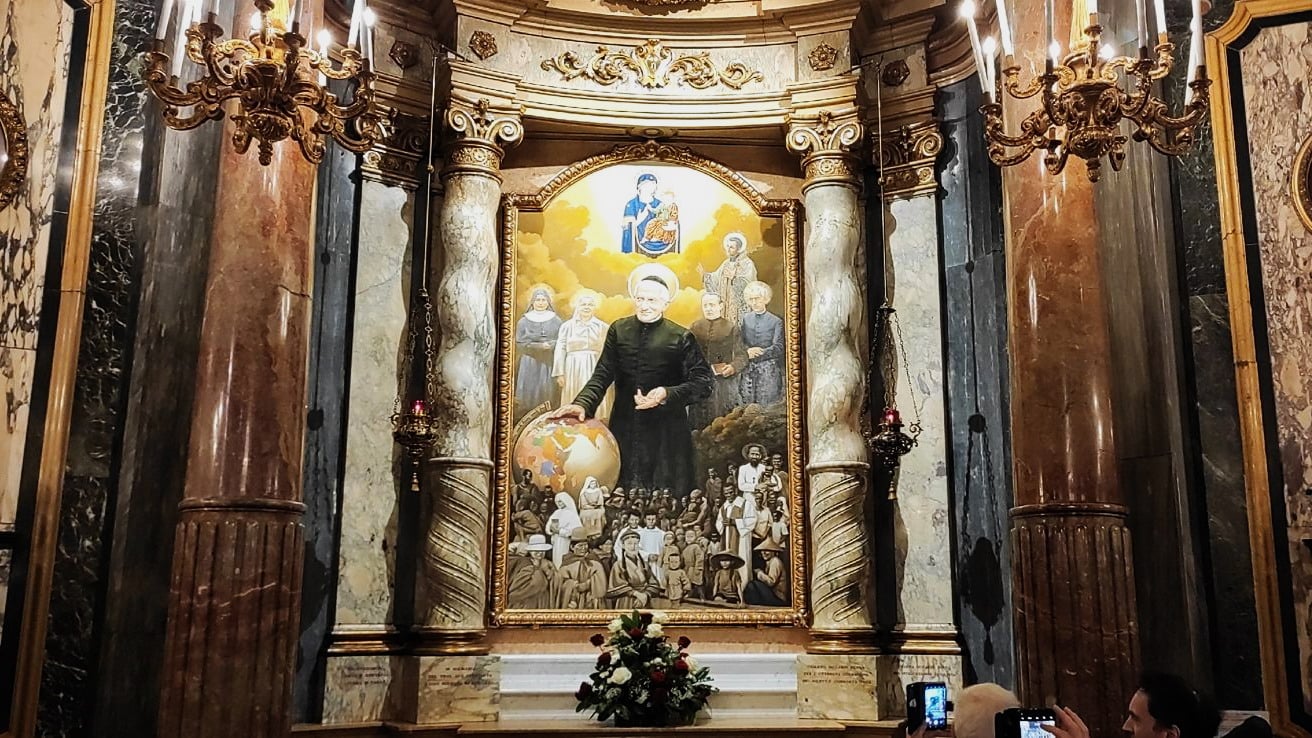
The Social Saints and the Consolata Shrine
In the Shrine, at the foot of the icon of the Consolata, many stopped to pray: common people, rich and poor, young and old; popes and members of the nobility. Among them all, however, the “social saints” of the 19th century stood out, who dedicated their lives to serving the poor, the marginalized, and all those in need.

Blessed Irene Stefani: a woman of sweetness and strength
Sister Irene Stefani, called Nyaatha by the Kikuyu people, embodied feminine strength and sweetness in her missionary consecration, bringing the ideal of Saint Joseph Allamano to a supreme degree of self-giving. The “Soft” Fortress of Nyaatha Sister Irene demonstrates that true strength lies in the ability to endure with gentleness. During the war, amidst mud, disease, and exhausting hardship, her dominant feminine quality was stability. “Her strength did not lie in shouting or imposing herself, but in remaining there, beside the wound, until it was healed.” And Father Giglio Domenico further states: Throughout the region, Sister Irene was well known; her visits were greatly welcomed, her passing brought joy, her warm and affectionate words enlightened those minds, instilling resignation, courage, and hope for a better future. To patience, charity, and zeal for the glory of God and the salvation of souls, she added a profound humility; indeed, in my opinion, this was her predominant virtue. Sister Irene, gifted with beautiful qualities of mind and heart, considered herself the last of all. Despite the times (early 1900s), Saint Joseph Allamano encouraged women to show extraordinary strength of spirit, seeing in them a unique capacity for resilience. “I want strong women, with great spirits, who are not afraid of difficulties. The mission requires generous hearts that know how to give themselves without reserve, with the strength that only love can give.” Intuition and Empathy – The Heart’s Eye Irene possessed that typically feminine quality of “feeling” a need even before it was expressed. She could read in her patients’ eyes what language (often different from her own) could not express. Her “Caress” was like medicine: she understood that a plague patient needed medical care, but even more so, not to feel like an outcast. Her caress broke the isolation of illness. One of her fellow nuns (Sr. Secondina Granero) remembers her thus: “Knowing someone was sick, she would have in her ardent heart go there to assist him, paying no attention to rain, nor cold, neither day nor night, nor tiredness, just to help him in everything with love. Furthermore, she no longer cared about thirst or hunger, just to help him and pray for the sick person that God’s will for him would be done, and to have everyone present pray; and she was desired by everyone because they saw that if that dear sister was there, things went well, whether she recovered or the hour of death had come. With the presence of that soul, everyone was happy.” Her frequent and, when he could, even prolonged visits to Jesus in the Blessed Sacrament, his ardour in speaking of God in his catechisms to the students at school, to the sick after their medical care, to the natives in their villages, were clear proof of the burning love of God with which his heart was inflamed. Irene, the Bride of Charity, of Holiness Nyaatha lived her consecration as a relationship of total love. Her “passion” was reflected in the way she treated each poor person: as if they were the Bridegroom, Jesus. Her femininity was therefore oriented towards the Other, in a gift of self that asked nothing in return. Allamano repeated that mission without holiness is merely empty philanthropy. The missionary was to be a “channel” receiving from God in order to give to others. He repeated to his missionaries, “First saints, then missionaries.” He didn’t want women rushing to do a thousand things while forgetting prayer. Their strength had to come from union with God, otherwise they would be “exhausted” by the toils of the field. “If we are not saints, we cannot sanctify others.” And Sr. Irene became a saint. Those who knew her as a postulant, novice, professed, and in the field of apostolate cannot help but repeat: “She was a saint.” Sr. Gabriella Margarino wrote: “I always observed in Sr. Irene a heroic charity; she always had one foot raised to serve others, regardless of whether she was at table or resting, engaged in urgent work, or engaged in interesting conversation. She was all eyes, all hands, all feet, all heart, all sacrifice to please and serve others, making no distinction between skin color…” Sr. Hellen Waithera, mc

Where Roots Intertwine – LOOKS from CULTURES
The story of Beatrice and Frank, a family that has made the encounter between cultures its vocation

Called to Rekindle the Fire – Interchapter 2026
On Monday, May 18th , a very important event of the Institute began in Turin, at the Motherhouse of the Consolata Missionary Sisters: the Interchapter. What is the Interchapter? Every six years, halfway through the six-year term of governance—that is, halfway between the current General Chapter and the next one—the Congregation pauses for a few days to meet, listen, and reflect on the concrete situation of its various realities. This is to evaluate the paths already undertaken and those yet to be undertaken. While in the General Chapter the designated Sisters make decisions, choose directions to take, and indicate specific mandates for the General or Continental Directorate, the Interchapter simply evaluates the steps taken and outlines those still to be taken to implement the six-year program. In the “dear nest” of the Family On the occasion of the centenary of the birth into Heaven of Saint Joseph Allamano, founder of the Consolata Missionary Sisters, the Interchapter is being celebrated in Turin, in the Motherhouse, a place steeped in history and many memories linked to the Founding Father. We are just a few meters from the tomb where his body rests, and not far from the Consolata Shrine, the place where the Institute was “born,” in prayer and dialogue with the Lord and with the Consolata. For the Interchapter, Sisters from four continents, representing the Institute’s leadership, have arrived, invited to “Rekindle the Fire.” The symbol of fire, very dear to Saint Joseph Allamano, was also chosen for the 2023 General Chapter, and represents the love of God, the Charism, and the passion for the mission. “It takes fire to be missionaries” the Founder used to say, inviting us to let ourselves be inflamed by the love of God, who wants everyone to be saved. This Interchapter is a call to rekindle the fire, the missionary passion, the Charism, and the vitality of the Consecrated Family. Three weeks Three weeks of meeting, dialogue, study, and formation. Discussion and evaluation. There will be moments of prayer in the sacred places of the Family: the tomb of Saint Joseph Allamano, the Consolata Shrine, and the very hall that welcome the Sisters present for the Interchapter, a place where the memory of the Founder’s visits to the Sisters is tangible. We ask for your prayers to accompany the group of Consolata Missionaries called to rekindle the fire, in profound union with the entire Family spread throughout the world. Sr. Stefania Raspo, mc

The icon of Our Lady Consolata
The icon of Our Lady Consolata retains its original Byzantine characteristics. The shapes, the colors: everything serves to depict the inner beauty of the woman and child.

Proverbs from Central Asia – WORDS from CULTURES
Proverbs are one of humanity’s great treasures. They translate into essential and rhythmic expressions the treasures that popular wisdom has accumulated over centuries or millennia. Today we present some proverbs from Asia, specifically the wisdom of Mongolian, Uzbek, and Kazakh cultures.

LIVING HOPE: Christ, who everyday wins death, lives among us
Inter-diocesan Catholic youth camp in Guinea Bissau This year we, the Catholic young people, had our national and inter-diocesan youth camp in Bafata, with the theme: Pilgrims of Faith,Hope and Love (Charity). The camp lasted for 3 days, from 24th to 26th April, in which we were also privileged to unite with the Christians of the Diocese of Bafata for their Silver Jubilee. It was a moment of exchanging ideas, sharing our faith in love that saves. It was a wonderful experience for us as young people, meeting and sharing our joys and struggles, particularly in this difficult and challenging era in which the world keeps changing so fast, the experience of lost identities, confusion, political instabilities, and immense poverty in all dimensions. It was our joy to meet our Apostolic Nuncio of Guinea Bissau, Cabo Verde, Mauritania and Senegal. It was a transformative encounter with Christ who is always present in our midst. Sometimes, due to many struggles we meet as young people, it’s hard to experience Christ in silence and therefore, we end up being hopeless and unhappy in life. The Bishop of Bafata, His Lordship Victor Quematcha guided us in a night vigil and adoration of the Holy Eucharist. He talked to us about the widow of Nain (Luke 7.11-17)whose only son had died and was in great agony thinking that it was over. At that moment Jesus revealed His great love for her and touched the woman’s son, raising him from the dead. His discourse was such consoling that helped us to see the world with the eyes of a true Christian. Looking at the world with hope for a better tomorrow despite the fact that so many young people are without jobs and live an extreme exclusion. Like that woman whose only hope was gone, our beloved land Guinéa Bissau for so long has suffered poor governance, health and education forcing young people to leave for other countries looking for jobs and a better life. Nevertheless, our eyes were opened and filled with a spirit of hope, renewed faith and great inner and radical desire to be testimonies of love to all, starting in our families,communities, parishes extending to the nation and to the whole world. We were encouraged that Christ, who everyday wins death, lives in us and in His own time what is due to us will be granted . We concluded with a solemn Mass on Sunday and our Bishop mandated us to be signs of hope,faith and true love in a world full of agony. Sr Purity Mutono, MC

LMC International Meeting – second day
The lay Consolata Missionaries are on the second day of the International Meeting.
Focusing on “Charism, Spirituality and LMC Identity”.

The LMC International Meeting
The LMC International Meeting started with a visit to the holy site of Castelnuovo, where our Saint Joseph Allamano was born. On arrival, the Consolata Missionary Sisters welcome the LMC and others IMC and MC, with enthusiasm and family warmth.