

Towards the Centenary of the birth into Heaven od Saint Joseph Allamano, Consolata’s Family listen to the Founder. In this article, Allamano is talking about the “something more” of our holiness. On February 17, 1926, the Turin newspaper Il Momento wrote: “The life of Canon Allamano is not counted using the calendar, but in his spiritual intensity, in his superior spirit, in the straightforwardness of his character, in the reflection of a good accomplished and silently stratified in the shadow of his beloved Shrine. He was not the man of ostentation. He was not the eloquent man. He was the man of industrious silence.” The search for quality of life, the effort to do well the good and thus be “extraordinary in the ordinary”, the “active silence”, the energy and enthusiasm, were always the characteristic aspects of his style of holiness which, speaking to his missionaries, he then qualified as “our holiness”. He discovered this “style” by approaching in particular the life and teaching of his holy uncle, Joseph Cafasso. He wanted to make it his own, not only because it was congenial to his personality, but because it was carefully studied, researched and cultivated. He imbued it with Christian virtues and strong evangelical references to the point of making it characteristic of his whole life and priestly ministry. This is how he explained to aspiring missionaries the phrase of Mk 7:37 ‘He did all things well’: “These three words [bene omnia fecit] deserve to be written on the walls of our houses and they should be able to be written on the tombstone at our death: he has done all things well”. And he explained how some people always look for great, extraordinary things, while God is present both in great things and in small things so we must be careful to always do everything well. Saints are saints not because they performed miracles, but because they did everything well. The Founder felt he was asking the members of the Institute for “something more” and a higher quality of life, precisely by virtue of their specific missionary vocation. For example, on August 19, 1917, speaking to the Consolata Missionary Sisters, he said: “Love our neighbour more than ourselves. For a missionary there must be something more.” On November 16, 1916, speaking to the missionaries about holiness, he asked himself: “And what should this holiness be? greater than that of simple Christians, higher than that of simple religious, distinct from that of secular priests. The holiness of missionaries must be special, even heroic and, at the opportunity, extraordinary so as to work miracles. Continuing the mission of the Apostles, they must be able to apply to themselves the words and deeds of Our Lord Jesus Christ.” Illustrating the individual virtues necessary for the missionary, our Saint loved to emphasize the value of each one and qualify it as the most important. What interested him was to accentuate their importance. An overall look at his teaching, on the need to become saints, allows us to grasp two complementary attitudes of this “more” in which the missionary must be equipped. 1. Quality Starting from the observation that a spiritual “normality” lowers the tone of our life and the effectiveness of our evangelization, the IX IMC General Chapter envisaged quality of life as the objective towards which to aim decisively: “We believe that, in the light of the life and teaching of our Father Founder and the demands of the mission, quality is an essential requirement to be always kept in mind at all stages of the life of the missionary” (p. 41). Allamano called this search for quality of life “our holiness”. He inculcated it in us Consolata missionaries until it became our “physiognomy”. It must begin first of all with the careful and scrupulous search for all the means that help us to walk decisively towards holiness, fulfilling all our duties well. It must then influence apostolic zeal, always keeping alive the “inner fire”. Fire, apostolic zeal, ardour, spending oneself wholly for others, were typical expressions of Allamano to describe the indispensable attitude of every missionary. For him, fire signified the love that must burn within us and which he identified with the Pauline expression “Charitas Christi urget nos” [the love of Christ impels us] (2 Cor. 5:14). Everything springs from love: “You must have so much charity that you give your very life. We Missionaries are devoted to giving our lives for the salvation of souls. Loving our neighbour more than ourselves must be the missionary’s life program.” Without this love there would be no reality, no substance of the apostolic man, and all our reflections would be pure academic thought and the resolutions envisaged would remain a dead letter. 2. Fidelity and the “nunc coepi” A precaution that our Saint still advised his missionaries in order to cultivate their vocation was to live intensely and well every day and every moment the “nunc coepi” [now I begin again]. In fact, the time of our existence unfolds moment after moment, day after day. The past is no more, the future is not there yet, only the present remains for me to realize my existence: I must live it well, giving meaning to everything I do, certain that in this way I fulfil God’s will and fulfil my vocation. He then suggested to his Missionaries fidelity in small things to ensure fidelity in the most important choices. Scrolling through the Spiritual Life, we immediately realize how important this conviction was for him. Here are some of his expressions, gleaned in his conferences, which find their common root in “fidelity”: For personal reflection

Humility in Forgiveness – Blessed Leonella Sgorbati
Today, let us pray, through the intercession of Blessed Leonella, for the Church, the disciple of Christ. Lk 6:37Do not judge, and you will not be judged; do not condemn, and you will not be condemned. Forgive, and you will be forgiven. Sr. Leonella says: You know, Lord, how absolutely important you are to me. I am yours in love, in reciprocity, I am yours and I want to be united with you at every moment”. Prayer for the intercession of Blessed Leonella: O God our Father, who through your Spirit, work in the midst of every people regardless of their culture or religion. Look with mercy upon humankind, who are often without peace and reluctant to forgive. Through the intercession of Blessed Leonella Sgorbati, “faithful and joyful disciple of the gospel” who shed her blood for love of you and for those most in need; give us the joy of being witnesses of your mercy and grant us the grace we ask of you…Through Jesus Christ, our Lord, model and origin of all martyrdom. Amen Blessed Leonella Sgorbati, pray for us.

The Courage to forgive – Blessed Leonella Sgorbati
Let us pray today, through the intercession of Blessed Leonella, for the families that are living in violence, that the balm of forgiveness may heal the wounds that deny them to live the fulness of life. Mt 6:14“For if you forgive other people when they sin against you, your heavenly Father will also forgive you” Sr. Leonella says: ”I hope that one day the Lord, in His goodness, will help me give Him everything or… He will take it away… because He knows that this is what I really want, He knows”. Prayer for the intercession of Blessed Leonella: O God our Father, who through your Spirit, work in the midst of every people regardless of their culture or religion. Look with mercy upon humankind, who are often without peace and reluctant to forgive. Through the intercession of Blessed Leonella Sgorbati, “faithful and joyful disciple of the gospel” who shed her blood for love of you and for those most in need; give us the joy of being witnesses of your mercy and grant us the grace we ask of you…Through Jesus Christ, our Lord, model and origin of all martyrdom. Amen Blessed Leonella Sgorbati, pray for us.

“I forgive, I forgive, I forgive!” – the last words of Blessed Leonella Sgorbati
Sr. Gianna Irene tells us about her missionary experience with Sr. Leonella and the last moments of Blessed Leonella’s life. That road… There was a busy road separating the hospital and our house. We used to cross it every day since it was our only “exit” and “entry”. Both the hospital and our house had large courtyards where we could take a walk after work. Each Sister had an armed body guard who accompanied us from work to home and vice versa. Sr. Leonella used to finish work before and could come to where I was, giving a hand even in “difficult cases.” If time permitted, we could take a walk around the hospital grounds before returning home. Those walks did us good, they were precious… exchanging ideas in improving our work, our lives, and giving us the opportunity to share our difficulties, improving our relationships with each other and the staff. That Sunday… It was a Sunday. Sr. Leonella was at work as usual, and the three of us Sr. Marzia, Sr. Annalisa, and I were at home; it was our day off. Sr. Maria Bernarda was in Italy for her holidays. It was shortly after 12:30p.m, we had just began to have lunch when we heard numerous gunshots. We were used to it and thus we didn’t pay attention. After about ten minutes, there was a loud knock on the door. It was one of the orphaned children crying, “Sisters, sisters come…Sr. Leonella, Sr. Leonella….he was emotional….and he didn’t say anything else.” We rushed to the hospital and found Sr. Leonella lying on bed in the operating room, surrounded by nurses and students trying to help. She was very pale, her eyes closed. We tried to encourage her, we helped stop the bleeding from the bullet holes. Unfortunately, there were no doctors present, thus we called the doctor on duty. We administered infusions, and in the meantime, the doctor on duty arrived and began the blood infusion. Those Words… Meantime, I had left Sr. Leonella to bring other necessary things when Sr. Marzia called me and said, “Sr. Leonella wants you“. I went to Sr. Leonella: she was very pale, she saw me, and then slowly said: I forgive, I forgive, I forgive! Those were her last words. She had nothing to forgive me, just as I had nothing to forgive her. We always understood and loved each other, and helped each other. Those three words were for her killers! Meanwhile, two doctors arrived, called from the other hospitals. Sr. Leonella began to have difficulty breathing then breathed her last without whimper. It was decided to transport the body of Sr Leonella by plane to Nairobi, and the three Sisters would also have to leave Somalia. We quickly packed our bags while the staff prepared Leonella’s body on a stretcher. We left for the airport where the plane was waiting for us. Along the way, people looked sad, as the news had already spread throughout the country. It is impossible to describe what we felt; there was only silence. Sr. Gianna Irene, mc

Leonella Sgorbati and Carlo Acutis: two lives interconnected by the Eucharist
At 6.45hrs on the 12th October 2006, a 15 years old boy from Milan was dying of an acute Leukemia. His Name was Carlos Acutis. Less than a month before, in Mogadishhu, Sr. Leonella Sgorbati, a sixty six year old Consolata Missionary, had been killed due to her Christian faith. She had spent her life for the Mission in Africa. An area for prayer has been created at Assisi , in the “Carlo Acutis Centre”, where significant relics of Carlo Acutis will be held, his red T shirt and his small bag. These will be held together with those of other saints. Among those relics, there is also that of the martyr Leonella, kept in a wonderful box by the Claritian Nuns. What ties these two persons together and yet so different? They both grew up in Milan. Both have been declared Blessed in the Catholic Church. But there are many other things that tie Carlo Acutis (who is to be canonized soon) and Blessed Leonella Sgorbati. These are: The Eucharistic Dimension “We have received an unexpected call from the Postulation of Blessed Carlo Acutis that was asking for a Relique of Blessed Leonella.” Sr. Renata Conti who was in charge of the process of recognition of martyrdom of Sr. Leonella “They gave the reasons for this request saying, in her (Bl. Leonella), there were many elements common to Bl. Carlo Acutis who is to be a saint soon. One of these elements is the Eucharistic dimension that has characterized the entire lives of holiness of the two”. This is confirmed by Mr. Antonio Nicolò, Secretary to the Friends of Carlo Acutis Association: “Reading the writings of Sr. Leonella, her deep and close relations with the poor and with the Eucharist is clear, the same can be seen clearly in the life of Carlo Acutis”. Carlo Acutis attended Mass every day. He says: “The Eucharist is my Highway to heaven!” This is the central point of all his life passed in friendship with God. From her young age, Rosa (baptism name of Sr. Leonella) was particularly attached to a “little book”, the Gospel, given to her by a Sister. Her relationship with God, very conscious right from youth, took a deep Eucharistic dimension till the end. Sr. Leonella felt deeply united with the Lord Jesus and she could affirm: The Martyrdom There is another spiritual aspect that connects Carlo Acutis to Sr. Leonella, perhaps not very evident: The martyrdom. It is noted that Carlo Acutis was building himself in digital apostolate (as it’s called today). He was passionate about informatics, he built various websites. In the summer of 2006, he took significant time constructing a website for Pontifical Academia “ Cultorum Martyrum”, whose goal was to deepen the worship and knowledge of martyrs. In a common broad sense, the term Martyr is the witness of faith and there is no doubt that Carlo Acutis was a Martyr in his young life. Sr. Leonella lived 50 years longer than Acutis and she did not only witness to faith with her life given to the missions, but she sealed it with her own blood. Her final words were “I forgive, I forgive, I forgive”. Whispered with deep agony but as a witness to the forgiveness of Christ on the cross. Two enterprising Saints The fame of the holiness of Carlo acutis spread quickly. A young and enthusiastic life that seems to have wanted to continue with the same energy in witnessing Christ. After only 20 years from his death, Carlo Acutis will be declared saint on Sunday 7th September by Pope Leo XIV. If Carlos Acutis has “won” the Course of canonization, (we write it with a smile), even Sr. Leonella was an enterprising person active on earth as she is now in heaven: “We say that our Sr. Leonella makes her own ways, she does not need us Consolata missionaries to make herself recognized, and this is very true” comments Sr. Renata. “Think of it, only in Italy, the presence of Sr. Leonella (her relics) is nearly all over, from North to South, not because the community has done animation… but because her life is a constant call, an absolute love capable of giving itself even up to martyrdom due to pure love”. An eloquent sign that interrogates, that provokes and that attracts. Carlo Acutis, Leonella Sgobarti saints recognized by the Church, bright and joyful witnesses of the beauty of the faith in Christ! Pray for us from heaven and accompany the persons that turn to you. The Carlo Acutis Centre (at Assisi, near the Hermitage of the Prisons) and its prayer area will be inaugurated after the canonization of 7th September. Stay tuned! Sr. Stefania, mc For more informations about Blessed Leonella Sgorbati, click here

My Mission in the Amazon Jungle: The Story of Sister Gladys Nduma (A Deeper Reflection) – part 2
The “Sweet Hearted Women” Group: Hope and Self-Sufficiency My dynamic vision led me to take on the ambitious initiative of the ‘Sweet Hearted Women’s’ group, recognizing a critical need. While it meant my efforts were initially “spread even thinner,” this expansion became a powerful force for holistic community development, empowering others and multiplying our collective impact – a profound consolation of shared purpose. The idea came from realizing that many women, victims of forced displacement and living in the urban area, found themselves unemployed, thus lacking basic needs such as food. This hard reality faced by many displaced families made the community reflect and seek strategies to respond to the situation. After seeing and hearing the women’s great dream was to have land so that they could cultivate food and sustain their families. Surely, as the word of God goes, knock and the door will be open. Our first knock was at the municipality, seeking the possibility of allocating land to the women. Surprisingly, the municipality granted two hectares of land. The formation and listening of women started, and they tirelessly worked on the land like ants, without resting until the land was all cultivated and planted. This initiative had an impact far beyond simple sustenance. It helped the women not only to provide food for their families but also to find a place where they could share their lives and dreams. The “chacra” (cultivated field) of the Sweet Hearted Women became a therapeutic place, where they share their secrets, worries, and offer each other support for the difficult situations experienced in their families. These women have become a true family to one another. They encourage each other not only in agricultural activities but also in family development, saving, participation in Mass, and supporting the Church. For me, all this translates the concept of consolation as a “significant presence with another person.” Accompanying Youth: Sowing Trust and Future Another significant experience was accompanying young people. My engagement with youth didn’t just start with catechism classes or with those who came to church. My experience with them was about finding them in the town square, starting conversations, asking to play with them on the sports courts, and gradually, with the help of other young people who were interested in forming a youth group, we managed to form a stable group of 42 young people. This group follows a methodology divided into 4 or 5 weeks in a month. The first week’s meeting is about catechetical formation, the second week is spiritual formation, the third week is mission, the fourth week is based on the life of the group, and when we have a fifth week, the youth meeting is based on evaluation and planning for the youths’ activities. We encourage each other to be faithful in all activities projected for personal nourishment and growth, both spiritual, physically, and toward the concentration of a society and the planet we dream to live in. After a long journey of accompaniment and reflection, the group has been able to stand alone to facilitate their formation and to be a group that can enlighten other groups within the jurisdiction and neighboring parishes. The joy of hearing the young people, maybe who ask to receive the sacrament after being in the group, or pinpointing some mission that they see important and that they can do within society, is fulfilling. We continue as a group listening to the impetus of the Holy Spirit who continues inviting the group to row the boat toward the deeper water of personal life. Thank be to God for this positive experience which has been fruit of many support from many well-wishers who have helped in spiritual support, material support, or emotional support. The True Essence of Mission and Continuous Formation This profound testimony reminds me that true mission isn’t about imposing but about immersing, learning, and loving, overcoming every personal and cultural barrier to bring consolation and hope to the persons with whom we serve. Every experience, positive or negative, on life’s journey, helps me to grow and to attune my life towards true consolation, a mission that continues to illuminate and accompany my path. Sr. Gladys, mc

Holiness and the Cross
Towards the Centenary of the birth into Heaven of Saint Joseph Allamano, a new reflection about Saint Joseph Allamano: holiness and the Cross “The cross is our book” (Saint Joseph Allamano) “All the more so as missionaries,” said St. Joseph Allamano, “we must know how to enter into the mystery of the cross.” In a certain way, we must be ‘experts’ in its mystery of salvation and in the suffering of the poor. This reflection on the cross is not an easy one: it was not so for the apostles who did not understand its meaning, it was not always so for St. Paul, although he went so far as to say: “Let there be no glory for me except in the cross of the Lord” (Gal 6:14), nor is it for us today. Yet, this reflection offers us the true key to understanding what our consecrated and missionary vocation is, and how to live it. How can I immerse myself in the lives of the people, in the tangle of suffering that accompanies so many peoples in today’s world, and become a voice of hope and consolation, a proclamation of salvation, without following the same path that Jesus travelled? How can I celebrate the Eucharist every day, the Sacrifice of Christ, and break the consecrated bread without remembering that Jesus’ words are first and foremost addressed to me: be you bread broken for your brothers and sisters, blood poured out that joins me for the salvation of the world… “Do this in memory of me”! Speaking of the new evangelization, Pope Francis reminded us of the context in which we live and work, and of our duty to “study the signs of the times.” He stated: “However, we cannot forget that most men and women of our time live in daily precariousness, with disastrous consequences. Some pathologies are increasing. Fear and despair take hold of the hearts of many people, even in the so-called rich countries. The joy of living is frequently extinguished, disrespect and violence grow, inequity becomes increasingly evident.” (Evangelii Gaudium, 52). What way must we follow to enter this world of suffering and be bearers of “good news”? How can we become, in Jesus’ way, “experts in suffering”? “My God, my God, why have you forsaken me” (Mt 27:46) These words are the beginning of Psalm 21(22), but they are above all the expression used by Jesus in the moment of the most atrocious pain, hanging on the cross. They were words of infinite suffering, as if he were saying: “Father, why do you leave me alone in this painful situation and do not intervene, am I not your Son? Jesus shed his blood; he gave his life into the hands of his enemies. What was left for him to give? The emptying (kénosis) of even his own “divine life”. Behind the facts of the passion described in the Gospel, there is a story of love between the Son and the Father, which culminates in this act of abandonment. The Founder uses a bold phrase from St. Francis de Sales: “Calvary is the theatre of lovers.” His suffering is no longer pain, but love and intimate union with his Father. The Father, seeing Jesus obedient to the point of being ready to regenerate his children, to give them a new creation, sees him so similar to himself, as if he were “another Father and Creator”. At that moment, Jesus is all ‘God’ because he is pure love. At the same time, he is closer than ever to sinful man and to man divided and distant from God. He experiences pain, the greatest pain, both physical and spiritual. Our suffering, our kenosis In his suffering, Jesus becomes a figure of every human pain, of every rupture and division, of every illness and of those pains that close us in on ourselves such as darkness, aridity, failure, loneliness. Jesus therefore shows us that the true dynamism of love, in which man finds that the fulfilment of his personal being is always crossed by a moment of death, of self-giving, of losing his own life. A moment, that is, of kenosis-emptying. Every true love that creates life brings with it this moment of not being, which is a prelude to a new fullness of being. There is no pain and suffering that cannot make us enter into this divine logic. Jesus came to give a name to every human pain, so that every pain, every cross is no longer “something”, but “Someone”. Every pain of ours and that of others hides a face of Jesus crucified. It is therefore necessary to know how to discover it and call it by its name. Pain is “a sacred thing”! Jesus told us: “As I have loved, you also must love one another”. As in a divine alchemy, the crucified Jesus is able to change all our pain into love, into communion. We need to recognize his face in every pain, to welcome it, to forget our pain and to begin to love the other. “The crucifix is the book to read every day” (St. Allamano) The Crucified One is the model for those who must carry out mission and unite the human family (“when I am lifted up from the earth, I will draw all men to myself” Jn 12:32). In fact, unity with the other is not possible without “I” emptying myself of myself. The only thing that has to stay in me is love. In other words, I must know how to die with Jesus, to lose everything. For mutual love to exist, I must be ready to lose everything: my ideas, my projects, my inspirations, even the most evangelical ones. I always have to put the other person before myself. This is possible only if I become ’empty’ for the love of the other. Jesus crucified is the teacher who leads to maturity. In the life of people and of the community there are two things that really make us

My Mission in the Amazon Jungle: The Story of Sister Gladys Nduma (A Deeper Reflection) – part 1
An extensive period of “listening to every voice” and “constantly reinterpreting” evolved into a profound understanding. This is the missionary experience of Sister Gladys in Colombia. I’m Sister Gladys Nduma, a Consolata missionary. Since my arrival in Colombia in October 2014, I’ve been on a journey that has profoundly shaped my vocation. After the first few months in Bogotá to sort out documents and learn a bit of Spanish, I was assigned to the community of La Tagua in the south of the country where I have been for 4 years before joining the community of Puerto Leguìzamo 25 km from La Tagua, in 2018. In both communities, I worked with the indigenous communities found along the river bank of River Caquetá, be it at the community level or in semi-urban settings, always working with adolescents, youths, catechists, and families. This was a period of intense learning and adaptation to the new reality. The experience has been deeply shaped by daily contact with the indigenous communities we regularly visited along the Caquetá River. It was there that I understood the true meaning of being a missionary: “Being a missionary for me doesn’t mean teaching; but having a big heart to learn from the people: their language, their cosmovision, their culture, even how they walk.” This profound cultural humility, born from my initial openness, truly facilitated a deep, incarnational witness. Any early “unnecessary difficulties” in learning basic survival skills directly from the community only deepened my understanding and respect, allowing for genuine connection and consolation. My gratitude goes to all the missionary team who accompanied and continue to accompany me in this mission. They teach me how to be with people, how to love what the people love, especially the culture, the gastronomy, the common dictum of the people, how to appreciate missionary life experience, how to live the present with continuous evaluation initiated at different levels, from personal to that of the local Church. Together, we transformed our community and our vicariate into a small Bethany. A place where many found spiritual and physical refreshment. This has been animated by the motto of the vicariate, “the Good Samaritan” – a call to all missionaries within to be Samaritans of the injured people within our boundaries and beyond. Thank you, sisters, thank you missionary team because walking together our small presence in the vicariate testifies for herself, thank our Monsignor Joaquin Umberto Guiza because of your humility, your support, your simplicity, encouraging words, your examples have been a compass that mark the right direction to follow in the mission. Visiting Riverine Communities: Learning from the People I remember my first clumsy days with a smile. How can I forget falling out of a boat and a five-year-old boy telling me: “Sister, you shouldn’t put your foot on the side of the raft; you should put it in the middle so you don’t fall again!” Yes, it was my first time to learn the balancing coming out of the boat; I had to learn even the obvious things in this context. Such moments, initially challenging, served to build authentic trust and deeper understanding, offering a powerful consolation of shared humanity. I learned to share a smile with anyone who approached me and to participate in the joy of “Murui” dances in the maloca. It was right there, in the maloca, that I learned to pray like the Murui, to listen to the Mother Earth, and to ask permission from living creatures. Here, I became aware that things do not just happen but they are ordered and I cannot take anything for granted. I had never thought before of the importance of asking permission from the tree to pick fruits, or asking for permission to enter the “madre terra” to pick woods or for other needs, yet the indigenous community has made me aware how important every action is. For these indigenous communities, we are interconnected, either by animated or inanimate beings, and we are all equal before each other. Respect and equality towards other beings is portrayed by a continuous awareness that human beings are not superior to any other beings. I learned to listen to the wisdom of the old one, who prescribed specific diets for spiritual growth, good interrelation among all, as well as learned to listen to the newly born who taught me the mystery of life. This extensive period of “listening to every voice” and “constantly reinterpreting” evolved into a profound understanding that informed every subsequent action, ensuring our solutions were truly contextualized and sustainable, a deep consolation to those seeking lasting solutions. Learning is not only about the new things but also capacity to relearn, to reinterpret what was already learned before, like how to plant the cassava. The openness of communities to learn and appreciate simple things such as the animation of the music known during the Mass taught me how to appreciate every instant, no matter how simple or small, like playing a guitar or playing a drum; these are things which make the days enjoyable. Celebrating the Mass on the leaves of the banana was among the simplest ways I can recall but a Mass celebrated with a lot of love and concentration and faith. The mission is for me a moment spent in the kitchen with the women learning how to prepare “caguana” with the village women or that moment they taught me how to sleep on the hammock, listening to each person’s story. I understood that consolation isn’t so much about indoctrination as it is about spending time in active listening, allowing our presence to speak to one another, making us feel desired and loved. My mantra became: “Accompanying each person from where they are, not from where I want them to be.” This commitment to “accompanying exactly from where they were,” even if it meant “avoiding difficult conversations” initially, proved to be the bedrock of trust-based empowerment. It created a safe space where true self-discovery and sustainable growth could flourish,

Holiness and God’s Will
Towards the Centenary of the birth into Heaven of Saint Joseph Allamano, a new reflection about Saint Joseph Allamano, holiness and God’s Will “In a remote African village, there was a leafy tree, with tall branches and green leaves. She was very proud to give shade to all the people and shelter to the birds. Everyone who passed by admired her. One day, a local inhabitant arrived with a saw and began to prune it. The tree was startled and cried out, “But why? I’m so strong, beautiful and full of leaves! Why do you cut me?” The man didn’t answer… He just continued his work calmly and precisely, removing dry branches and even some green ones. The tree felt pain, sadness and misunderstanding. For weeks she felt diminished, empty and ugly. As she no longer received compliments, and the birds were gone, she thought: “It’s that man’s fault… destroyed my life!” The rainy season came, and with it a new life for the tree: new branches sprouted, stronger, more beautiful. The birds returned, the shade became larger, and the fruits began to grow, something that the tree had never had. Then she understood: “The pruning of the silent man was the will he had for me… and it was for my good, because only by pruning could I bear fruit.” How often, like this tree, do we not understand the “pruning” that life brings us: moments of pain, loss, humiliation or apparent failure. We find it difficult to perceive that, behind these situations, there is a greater love, which silently prepares something more beautiful and fruitful for us. This pruning we can call God’s Will! Pope Francis has often spoken to us about God’s will, especially highlighting 4 fundamental aspects: Discerning God’s Will in concrete life: God’s will is not something abstract or distant, since it manifests itself in the concrete situations of everyday life: “To discern is to seek to recognize God’s will in the signs of the times and concreteness of life.” God’s Will is always Love and Mercy: God’s will is never something that humiliates or destroys us: “God wants all men to be saved and to come to the knowledge of the truth.” Abandoning oneself with trust like Jesus: Trusting and surrendering to God’s will is an act of love and faith: “God’s will is not a kind of blind destiny. It is a project of love for each one of us.” God’s Will and Christian Joy: when we accept God’s will, we find peace and joy: “Doing God’s will requires listening, prayer, and generosity. But this is what leads us to true happiness.” One day, talking to the Consolata Missionary Sisters, St. Joseph Allamano concluded: “I tell you th++at my greatest consolation is that I have always done the will of God.” On another occasion, explaining to the students why he had dismissed a coadjutor who had not obeyed, he said: “But nothing falls without the will or permission of God… For this reason, I prayed in these Exercises that the Lord would give me not only conformity to his will, but uniformity, and I said: I do not want my will to be done here, but only the will of God.” Doing God’s will was for Allamano the secret to becoming a saint, in order to meet God and to fully realize his missionary vocation. He was deeply convinced of this, to the point that he not only scrupulously tried to do it himself, but also constantly reminded others of it in his lectures. It was from this concrete and persevering experience of God’s will that St. Joseph Allamano came to understand and teach that on the spiritual path there are different stages in one’s total abandonment to the divine will. It is not only a matter of accepting with resignation what God permits, but of growing progressively in our union with him, until the human will itself conforms, unites and finally disappears within the sovereign will of God. It is in this horizon that he proposes three distinct degrees, which despite having their origin in the ascetic and mystical theology of saints such as St. Alphonsus Mary de’ Liguori, Allamano always promoted them with his missionaries: Conformity consists in recognizing the divine will and adjusting our choices to it, even if our own will still remains distinct: “The first step to perfection is to conform one’s will to the will of God; that is, to accept all that God wills and to reject that which God does not want.” Uniformity is a deeper step: it means merging our will with God’s will: “When we are united to God’s will, our will and God’s will become one, because we want nothing else but what God wills.” Deiformity is the highest degree. It is when we completely erase our own will, merging it in such a way with the divine will that only the will of God remains: “The more perfectly we are united to the will of God, the holier will be our life. One who is thus united can say: ‘Lord, do with me and with all that is mine what is pleasing to you.’“ To understand this path of surrender to the divine will, there is nothing better than to look at the example given to us by Jesus Christ, who always lived and testified to be in conformity with the will of the Father. St. Joseph Allamano, in his own words, helps us to deepen this desire for what God wants in the simplest way: “The Lord said: Non mea voluntas, sed tua fiat. Not mine, but your will be done. So, there were two, and He conformed His will to the Father’s. When he said that he did what his Eternal Father wanted and that it was not He who worked, but his Eternal Father, it was an intimate union that ceased his will and only the will of God remained. Both in his words and in his actions, he shows the
My YES is to do the will of God
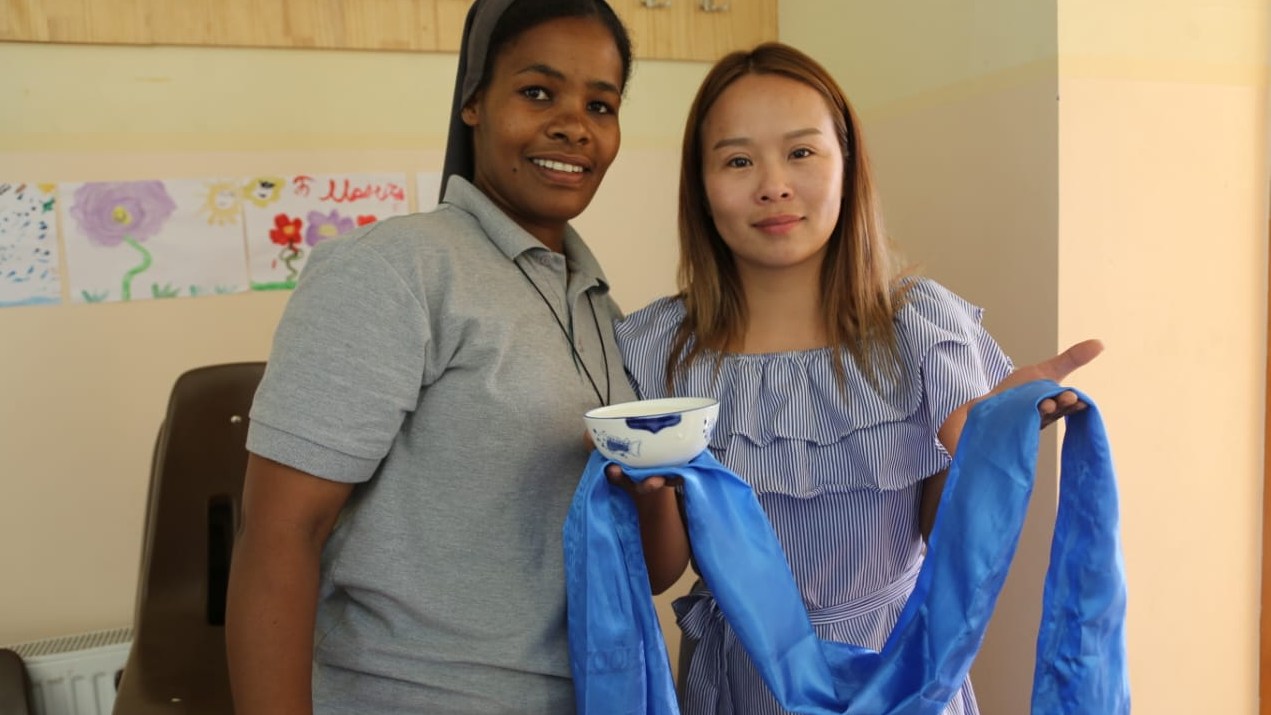
I am Sr. Tireza Gebriel from Ethiopia, born in 1984. I made my first profession on March 28, 2016, in Kenya (Nazareth). Then I received my first destination in Asia, specifically in Mongolia, in April 2018, and I have been serving the Lord in Mongolia ever since. I would like to share my experience of joy in my mission, connecting it to the vocation of Abraham, which inspires me to contemplate my life in mission. It is a journey of faith towards the Promised Land. God said to Abraham: “Leave your country, your people, and your father’s household, and go to the land I will show you.” The voice of God comes to each person in different ways, making us aware of His presence. The journey of faith requires encountering God and surrendering to Him. Why does God call us and ask us to leave behind our country, culture, language, and to go to new people who may not know Him or are non-Christians? The call of God is free, sovereign, and moved by the Spirit of love for humanity. But it is also very demanding and requires detachment. The love of God, beyond everything, wins the hearts of humanity by making us abandon ourselves to do His will. Responding to God’s call involves an encounter between two persons. It is a time to welcome grace into my life and to trust more in Him. God loves me as I am. He is merciful despite all my weaknesses. When there is communion with God, there is light and joy. I continue to contemplate God’s creation, made through His Word: “God saw that all He had made was very good” (Gen 1:31). There is always a beginning in our lives. God gives us names and calls us by name. Even today, God calls us by our name and entrusts us with His mission. Abraham was called and sent; his name was changed to “father of faith.” Abraham experienced deep intimacy with God and a listening heart. When God touches our hearts, everything changes in our lives. I have been challenged to understand my inner voice and the voice of God. It’s not easy to describe. If I am silent, does it mean there is peace within me? Can inner silence help me understand the noise of the outside world? When I face challenges, my inner voice often remains confused, and I feel emptiness. Sometimes I have no words, just silence in front of the Tabernacle. I started searching for the One who called me, seeking to see His face. Opening the gate of my heart to Him, I feel that He is always near, even if I am not fully aware of His presence. When there is a relationship with God, there is peace; only God knows the inner path of my life. God journeyed with Abraham with an open heart until the very end. Where there is communion, there is transformation. God can transform us if we desire to sacrifice our lives. The mission of God requires total sacrifice and patience. Vocation is a gift from God, and a missionary vocation is a mystery. I often imagine: when Jesus came into this world, did He run away from challenges? Why did Jesus obey and give His life on the cross? Did the disciples follow Him because life was easy? Without suffering or sacrifice, there is no true life. It is a personal journey to welcome the grace and blessing of the mission. Challenges help us grow and open our hearts to new realities. Sr. Tireza, mc