
This year we celebrate the hundredth World Mission Day. At the origin of its establishment lies the vision and initiative of Saint Giuseppe Allamano and the Italian missionary institutes. Although things did not go smoothly right from the start…
World Mission Day is celebrated globally by the Catholic Church on the penultimate Sunday of October. This year, it is falling on October 18, 2026. World Mission Sunday, as it is usually called, was established in 1926 by Pope Pius XI. It supports missionary work in developing regions through prayer and the Universal Solidarity Fund. We could therefore say that the fruits of World Mission Sunday encompass the tangible spiritual, pastoral, and material impacts generated by the global Catholic Church’s annual day of prayer and financial solidarity. All these are coordinated by the Pontifical Mission Societies, and directly sustain over 1,130 mission dioceses primarily across Africa, Asia, Oceania, and Latin America.
Every year, we all celebrate the Mission Sunday, but no one mentions St. Joseph Allamano in connection to it. However, the truth is that the Church began looking at the importance of this day, after the provocation by St. Joseph Allamano and his colleagues. Do you know what he did? Well, I will tell you. Although the Founder was a diocesan priest, he did not in any way close his eyes on the ecclesial reality around him.
Like all diocesan priests, he was preaching the word of God, confessing hundreds and hundreds of people and counseling many more. The Church of Turin, which had an abundance of priests, was doing well. Including collecting money and sending it to the missions. However, the fear with which the Turinese clergy treated the issue of sending a few priests as missionaries to Africa appalled our Founder.
Saint Joseph Allamano and the Missions
St. Joseph Allamano was convinced beyond any doubt that the entire Church is missionary and the work of evangelization is God’s people’s basic duty. To those who had an unexplained fear of missionary activity, St. Joseph Allamano used to remind them that even bishops being members of the Episcopal body that succeeded the apostolic college, are consecrated not merely for the dioceses, but for the salvation of the whole world.
Wondering almost aloud about why it was difficult for others to see those facts, St. Joseph Allamano decided he could not just sit and watch as things ‘went south’. In truth, there were some congregations and orders that were doing a lot of missionary animation all over Italy using slides taken from every continent. As far as the Consolata Missionary Institute was concerned, Fr. Lorenzo was giving missionary talks here and there, supported by the slides that Bishop Perlo was sending to him.
Even with all those efforts the Founder could tell that something more drastic was needed to wake up the Italian Church from some form of missionary slumber. He ended up telling Fr. Camisassa one day, that there was a need to draw the pope into the issue, if it had to acquire the importance it deserved, and have the impact that was needed.
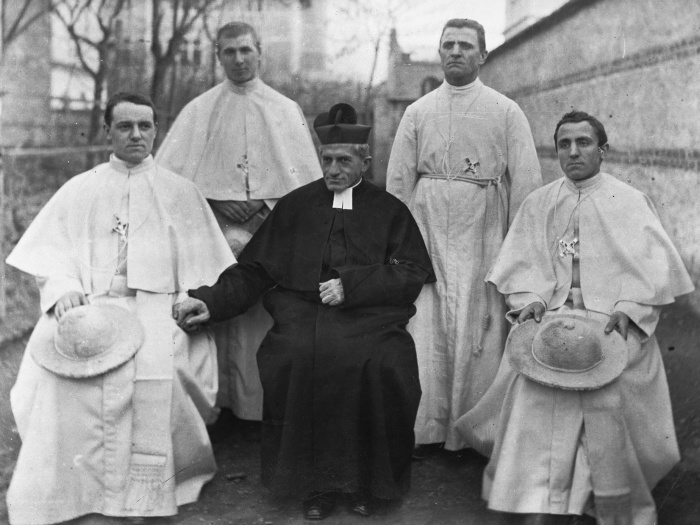
He involved missionary institutes
Acting on his guts, St. Joseph Allamano wrote a letter to five superiors of Italian Missionary Institutes on 29th August 1912, describing the situation. He was of course sure that many people in Italy knew the situation well, only that no one had the courage to raise it up. The five included: Bishop Conforti of Parma, Fr. Vianello of Verona, Fr. Figano of Milano, Fr. Traverso of Genoa and Fr. Callerio of Rome. St. Joseph Allamano’s letter to the five did not beat about the bush.
He outlined clearly that first, there was massive ignorance of missions in Italy. Secondly, that there was a general apathy among clergy and faithful. And thirdly, there was a scarcity of specialized vocations partly due to that fact that the bishops discouraged them even openly. He also noted that there was a need to appeal to the pope to intervene personally on the matter as the head of the Church on earth.
The five Superiors accepted his idea, and in a very respectful language, they drafted a letter to Pope Pius X. In the letter, they explained the situation of the Church in Italy, the issues they believed needed fixing, and concluded it with a request for the introduction of a mission Sunday, to be celebrated annually, with the obligation of a homily on the duty and methods of propagating the faith throughout the world.
A project and many obstacles
This gives us a picture of St. Joseph Allamano that is fascinating. In his frail looking body, he was a silent force to reckon with – a mover of things in silence. Having written to Pope Pius X, St. Joseph Allamano and his colleagues waited with baited breath. Their letter however encountered various accidents on its course. First, the Congregation of the propagation of faith (Propaganda Fide) refused to give its official support to the Pope.
Secondly, the signatories made further mistakes, when instead of presenting the petition to the pope in person, they had it delivered by Fr. Callerio on his own. Thirdly, Fr. Callerio, not able to find Pope Pius X, who was tied up with Christmas ceremonies, decided to deliver the letter to his secretary Fr. Bressan.
Fourth, the Pope’s physical strength was waning; and finally, he was deeply concerned about the state of peace, as the drums of the First World War were already sounding across Europe.
The Pope’s Response
In other words, all odds were against their petition. For that reason, when Pope Pius X responded to the letter on 31st January 1913, he did not address the whole Church nor the bishops as St. Joseph Allamano and his colleagues had wished. Instead, he addressed his reply to the six Superiors, agreeing about the great duty of missionary work and praising them for the care they were taking in training teams of evangelizers.
The Pope did not say anything about the responsibilities of the bishops in supporting missionary efforts, nor did he say anything about the Mission Sunday. Worse still, the Vatican bureaucracy complicated everything by messing up the promoter’s name and address. Instead of writing Canon Allamano, they wrote Canon Alemanno the Superior of the Immaculate Missionaries. Certainly, it must have been very disappointing for St. Joseph Allamano and his colleagues. Very disappointing indeed.
However, instead of cherishing resentment and frustrations as many people would have done, St. Joseph Allamano in silence and prayer took to disseminating and commenting on the letter that the pope had written to them as a reply. With it, it was easy to arouse enthusiasm for the missions.
The project is being realized (14 years later)
Although St. Joseph Allamano and his colleagues did not succeed in making the Pope address the whole Church, the issues they raised expressed their genuine concerns for the work of evangelization in the world. In addition, the fact that the Pope responded to their petition, was a clear sign that he concurred with them that their concerns were valid.
Although the Pope did not set up the Mission Sunday as St. Joseph Allamano had wished, the necessity of such a day had been noted. That is why in 1926, the year that St. Joseph Allamano died, Pope Pius XI instituted the Mission Sunday as a day of praying for missions and reflecting on the Church’s commitment to evangelizing the world. The Mission Sunday was fixed to be celebrated on the penultimate Sunday in the month of October and the first Mission Sunday was celebrated in 1927 – a year after St. Joseph Allamano’s death.
As we celebrate the centenary of the creation of the World Mission Sunday, let us thank the Lord for the life and missionary insight of St. Joseph Allamano, our Founder, who was instrumental in the creation of this important day.
Fr. Jonah Makau, IMC
Postulator